
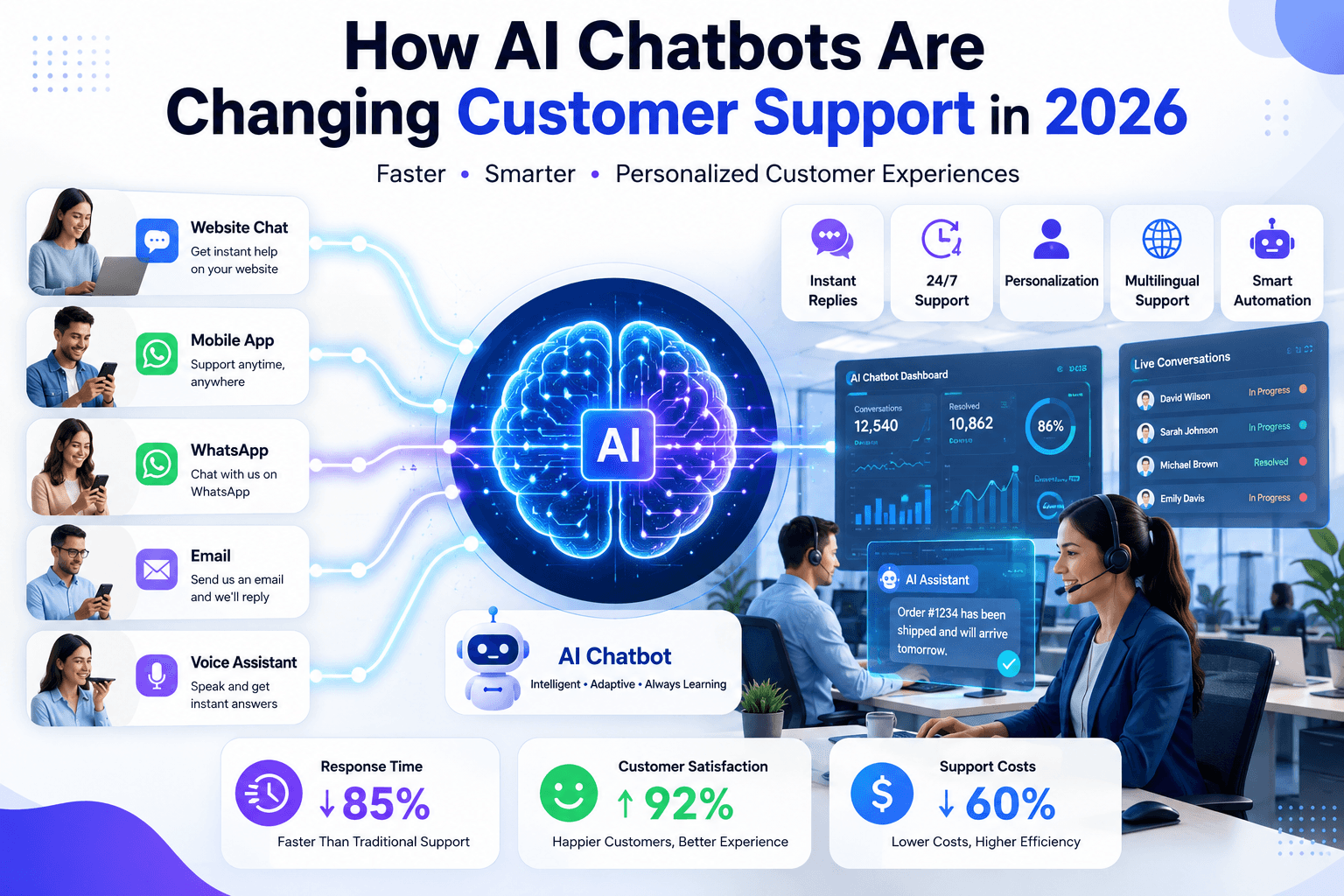
Customer expectations have evolved dramatically over the last few years. In 2026, businesses are no longer competing solely on products or pricing—they are competing on customer experience. As a result, organizations across industries are investing heavily in artificial intelligence to improve service quality, reduce response times, and deliver personalized support at scale.
One of the most transformative technologies driving this shift is the rise of AI chatbots. Modern AI-powered assistants have moved far beyond simple scripted responses. Today’s solutions can understand context, analyze customer intent, retrieve information instantly, and even perform complex tasks without human intervention.
Businesses looking to modernize their digital services often work with experienced technology partners such as Technobot System to build intelligent customer support platforms that combine automation, scalability, and exceptional user experiences.
In this article, we’ll explore how AI chatbots are changing customer support in 2026, the benefits they provide, emerging trends, implementation challenges, and what organizations should expect in the future.
The Evolution of AI Chatbots
The first generation of chatbots relied heavily on predefined rules and decision trees. While these systems could answer simple questions, they often struggled with complex customer interactions.
Today, AI chatbots leverage:
- Natural Language Processing (NLP)
- Large Language Models (LLMs)
- Machine Learning
- Predictive Analytics
- Knowledge Graphs
- Voice Recognition Technologies
As a result, modern chatbots can engage in human-like conversations, understand customer intent, and continuously improve through learning.
Instead of responding with generic answers, AI chatbots in 2026 can:
- Understand context from previous conversations
- Personalize responses based on customer history
- Detect emotions and sentiment
- Offer proactive assistance
- Escalate complex issues intelligently
This evolution has transformed chatbots from simple support tools into strategic customer experience assets.
How AI Chatbots Are Changing Customer Support in 2026
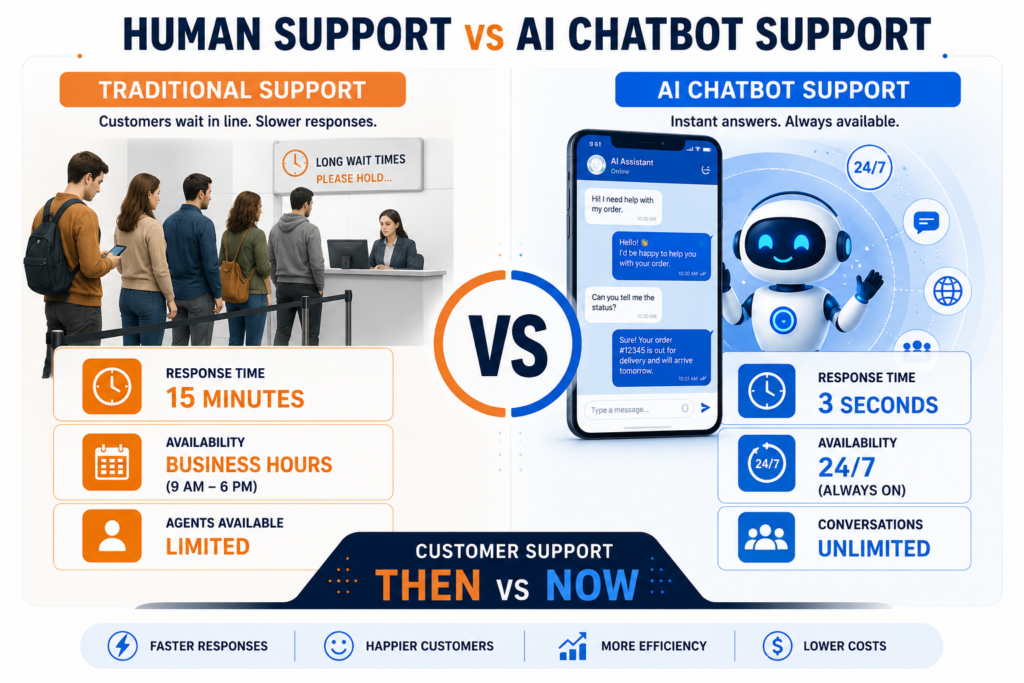
The impact of AI chatbots on customer service is significant. Organizations are using them to streamline operations while simultaneously improving customer satisfaction.
Let’s explore the major changes happening in customer support today.
1. 24/7 Customer Support Without Increasing Costs
One of the biggest advantages of AI chatbots is their ability to provide support around the clock.
Customers expect instant assistance regardless of:
- Time zones
- Business hours
- Holidays
- Peak traffic periods
Hiring and managing large support teams for continuous coverage can be expensive. AI chatbots solve this challenge by handling thousands of conversations simultaneously.
Benefits include:
- Reduced waiting times
- Improved customer satisfaction
- Lower operational costs
- Consistent service quality
For global businesses serving customers across multiple regions, this capability has become essential.
2. Faster Response Times and Issue Resolution
Modern customers dislike waiting.
Research from Gartner consistently highlights the growing importance of speed in customer interactions.
AI chatbots significantly reduce response times by:
- Instantly answering common questions
- Retrieving customer information
- Providing self-service options
- Guiding users through troubleshooting processes
Instead of waiting several minutes—or even hours—for human assistance, customers can receive immediate support.
This not only improves customer experience but also increases operational efficiency.
3. Personalized Customer Experiences at Scale
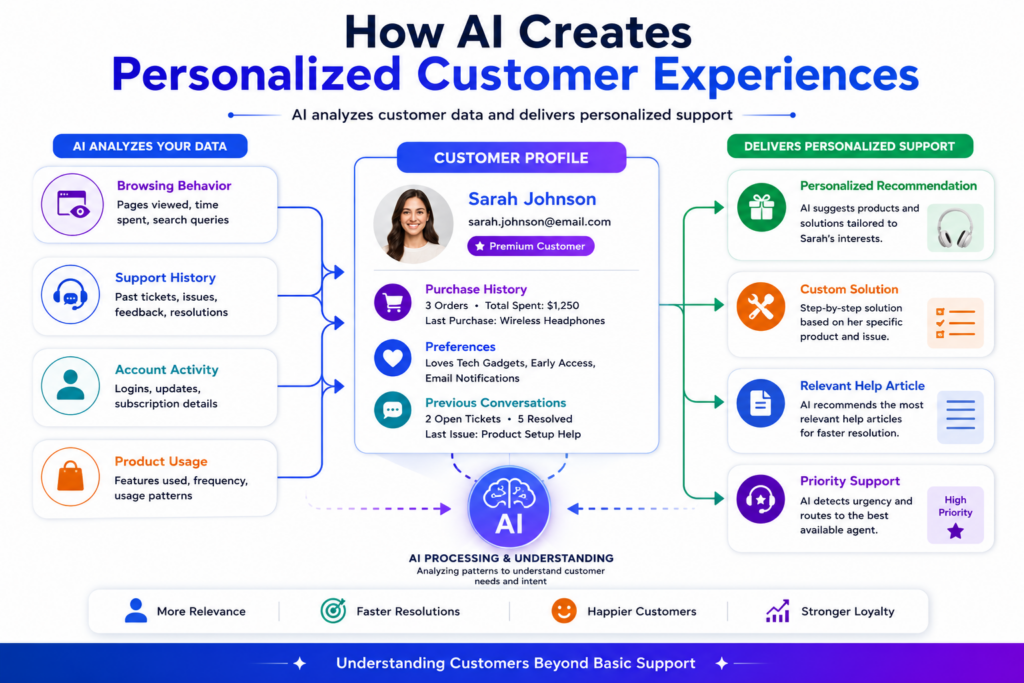
Personalization has become a major competitive advantage.
AI chatbots can analyze:
- Purchase history
- Previous support interactions
- Customer preferences
- Browsing behavior
- Account activity
Using this information, chatbots provide highly relevant responses.
Examples of Personalized Support
A customer contacting an eCommerce company may receive:
- Product recommendations based on previous purchases
- Order-specific updates
- Customized promotions
- Personalized troubleshooting steps
Similarly, SaaS companies can offer account-specific guidance and onboarding assistance.
This level of personalization would be difficult and costly to achieve manually across thousands of customer interactions.
4. Multilingual Support for Global Customers
As businesses expand internationally, language barriers can create customer service challenges.
AI chatbots now support dozens of languages with impressive accuracy.
Benefits include:
- Better customer engagement
- Improved accessibility
- Consistent support across regions
- Reduced dependency on multilingual support teams
Many organizations are using AI to serve customers globally without significantly increasing staffing costs.
This capability is particularly valuable for businesses offering digital products and international services.
5. Intelligent Self-Service Experiences
Customers increasingly prefer solving problems themselves when possible.
AI chatbots support this trend by providing:
- Guided troubleshooting
- Knowledge base access
- Interactive FAQs
- Step-by-step instructions
- Automated account management
According to customer service trends published by Microsoft Work Trend Insights and other industry leaders, self-service options continue to gain popularity among users seeking quick resolutions.
Common Self-Service Tasks
Customers can use chatbots to:
- Reset passwords
- Check order status
- Update account information
- Track shipments
- Schedule appointments
- Request invoices
As a result, support teams can focus on more complex customer issues.
6. Reduced Workload for Human Support Teams
A common misconception is that AI chatbots replace customer service agents.
In reality, the most successful implementations use AI to support human teams rather than replace them.
Chatbots handle:
- Repetitive inquiries
- Frequently asked questions
- Initial customer interactions
- Basic troubleshooting
Meanwhile, human agents focus on:
- Complex technical issues
- Escalations
- Relationship management
- High-value customer interactions
This collaborative model improves efficiency while maintaining a human touch where it matters most.
7. AI-Powered Sentiment Analysis
One of the most exciting developments in 2026 is sentiment-aware customer support.
Advanced chatbots can identify:
- Frustration
- Anger
- Satisfaction
- Urgency
- Confusion
When negative sentiment is detected, the chatbot can:
- Adjust its tone
- Prioritize the request
- Escalate to a human agent
- Offer alternative solutions
This capability helps businesses resolve issues before they escalate into customer dissatisfaction.
8. Proactive Customer Support
Traditional customer support is reactive.
Customers encounter problems and then contact support.
AI chatbots are changing this model through proactive engagement.
Examples of Proactive Support
Chatbots can notify customers about:
- Service disruptions
- Payment issues
- Subscription renewals
- Product updates
- Security alerts
For example, if a system detects unusual account activity, a chatbot can immediately contact the user and provide assistance.
This proactive approach enhances trust and reduces support tickets.
AI Chatbots in Different Industries
The adoption of AI chatbots is expanding across nearly every industry.
Healthcare
Healthcare providers use chatbots for:
- Appointment scheduling
- Patient inquiries
- Medication reminders
- Symptom assessments
Banking and Finance
Financial institutions leverage AI chatbots for:
- Account inquiries
- Transaction monitoring
- Fraud alerts
- Loan information
E-Commerce
Online retailers use chatbots for:
- Product recommendations
- Order tracking
- Returns management
- Customer support
Education
Educational organizations utilize AI chatbots for:
- Student support
- Course guidance
- Enrollment assistance
- Administrative queries
Many organizations seeking industry-specific chatbot solutions are increasingly partnering with custom software development experts and exploring insights from technology resources such as the Technobot System Blog to understand implementation strategies and emerging trends.
The Business Benefits of AI Chatbots
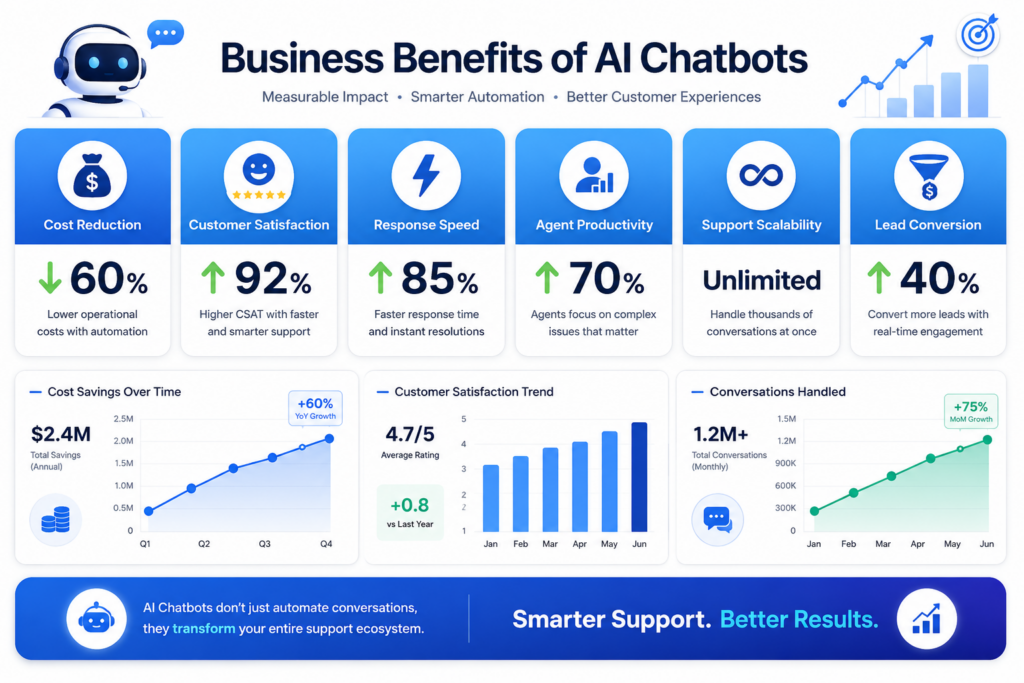
The growing adoption of AI chatbots is driven by measurable business outcomes.
Cost Savings
Organizations can reduce customer support expenses through automation.
Improved Customer Satisfaction
Faster responses and personalized service increase customer happiness.
Higher Agent Productivity
Support teams spend less time handling repetitive inquiries.
Better Scalability
Chatbots can manage thousands of conversations simultaneously.
Valuable Customer Insights
AI systems collect data that helps organizations understand customer behavior and improve services.
These benefits make chatbot investments attractive for businesses of all sizes.
Challenges Businesses Must Consider
While AI chatbots offer significant advantages, implementation requires careful planning.
Data Privacy and Security
Customer conversations often contain sensitive information.
Organizations must ensure:
- Secure data handling
- Compliance with regulations
- Proper access controls
- Encryption standards
Training and Optimization
AI chatbots require ongoing improvement.
Businesses should continuously:
- Review conversations
- Update knowledge bases
- Monitor performance
- Improve response quality
Human Escalation Paths
Not every issue can be solved through automation.
Customers should always have access to human support when needed.
Managing Customer Expectations
Transparency is important.
Users should understand when they are interacting with an AI assistant and when human assistance is available.
Emerging AI Chatbot Trends in 2026
Several innovations are shaping the next generation of customer support.
Voice-Based AI Assistants
Voice interactions are becoming increasingly natural and accurate.
Generative AI Integration
Large language models enable more conversational and context-aware support experiences.
Hyper-Personalization
AI systems are delivering increasingly individualized recommendations and assistance.
Omnichannel Customer Support
Chatbots now operate seamlessly across:
- Websites
- Mobile apps
- Social media
- Messaging platforms
- Customer portals
Predictive Customer Service
AI can identify potential issues before customers even report them.
These trends will continue redefining customer support strategies over the coming years.
How Businesses Can Successfully Implement AI Chatbots
Organizations considering chatbot adoption should follow a structured approach.
Define Clear Objectives
Identify goals such as:
- Reducing support costs
- Improving response times
- Increasing customer satisfaction
Choose the Right Technology
Select platforms that align with business requirements and customer expectations.
Integrate Existing Systems
Connect chatbots with:
- CRM platforms
- Helpdesk software
- Knowledge bases
- Business applications
Monitor Performance
Track key metrics including:
- Resolution rates
- Customer satisfaction scores
- Response times
- Escalation frequency
Continuously Improve
AI chatbots perform best when regularly optimized using real customer interactions.
Businesses seeking customized chatbot solutions, AI-powered web applications, or enterprise software integrations often work with experienced development providers such as Technobot System’s Custom Software Development Services to ensure their implementations are scalable, secure, and aligned with business goals.
Conclusion
The transformation of customer service is accelerating, and AI chatbots are changing customer support in 2026 in ways that were unimaginable just a few years ago.
From providing 24/7 assistance and multilingual support to enabling proactive service and personalized customer experiences, AI chatbots are becoming essential tools for modern businesses.
However, success requires more than simply deploying a chatbot. Organizations must focus on strategy, customer needs, security, integration, and continuous improvement. When implemented correctly, AI chatbots can enhance customer satisfaction, increase operational efficiency, and create a significant competitive advantage.
As artificial intelligence continues to evolve, businesses that embrace intelligent customer support solutions today will be better positioned to meet the expectations of tomorrow’s customers.
Tags
Share this article
About the Author
Experienced IT professional specializing in enterprise solutions and modern technology implementations.
Related Articles
Stay Updated
Get the latest IT insights delivered to your inbox.