
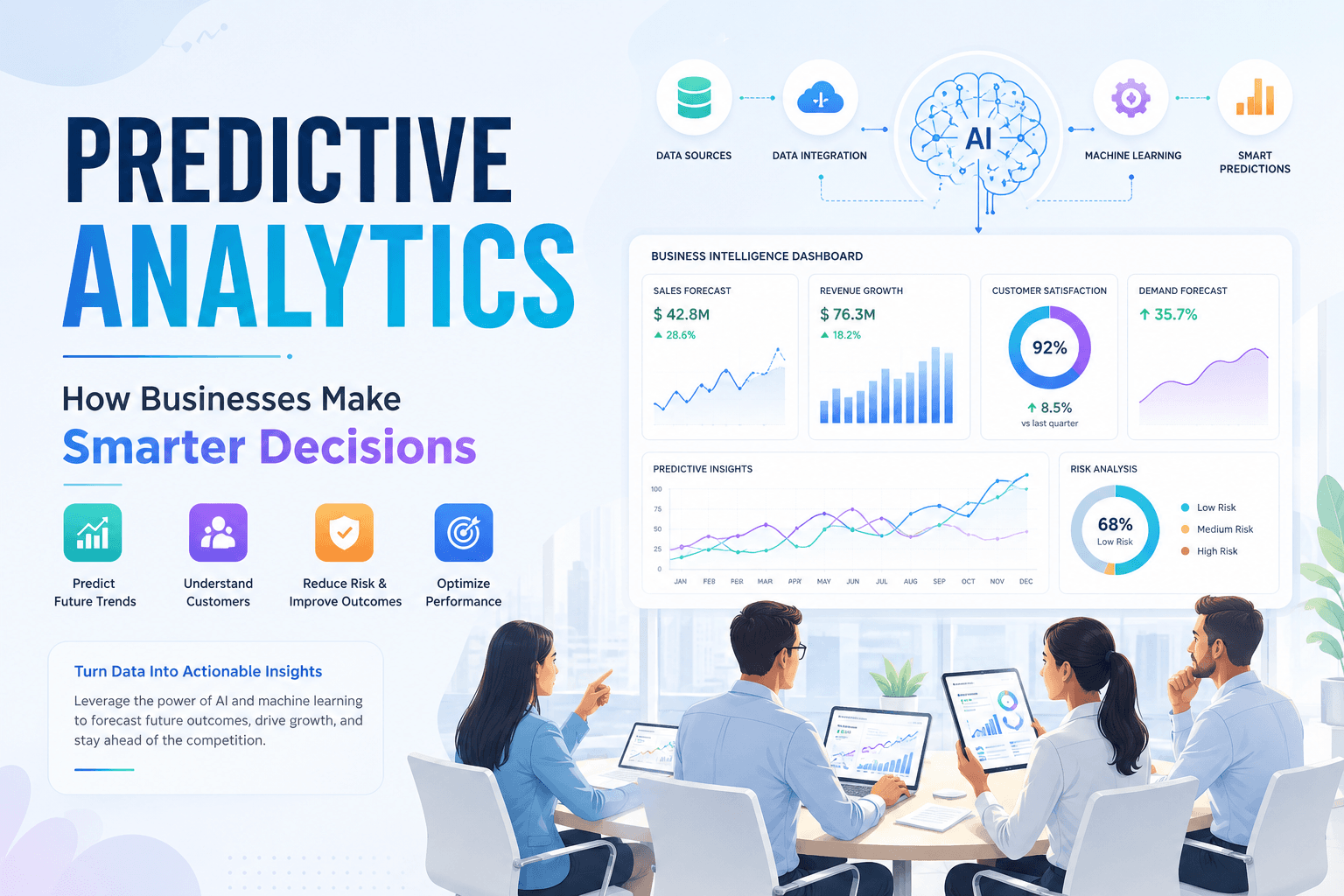
In today’s fast-moving digital economy, businesses generate massive volumes of data every second. From customer interactions and website traffic to sales transactions and operational workflows, every activity creates valuable information. However, collecting data alone is not enough. The real advantage comes from understanding what that data means and using it to make better decisions.
This is where predictive analytics becomes a game-changing business strategy.
Predictive analytics helps organizations identify future trends, customer behavior, operational risks, and market opportunities using historical data, machine learning, artificial intelligence, and statistical algorithms. As businesses continue to digitize their operations, predictive analytics is rapidly becoming a core technology for companies that want to stay competitive and scalable.
Modern businesses increasingly rely on custom software solutions and intelligent platforms to process large datasets effectively. Many organizations are now investing in custom software development solutions to build scalable systems capable of handling predictive analytics workflows, automation, and data-driven decision-making.
In this blog, we will explore how predictive analytics works, why it matters, how industries use it, the technologies behind it, challenges businesses face, and practical strategies for successful implementation.
What Is Predictive Analytics?
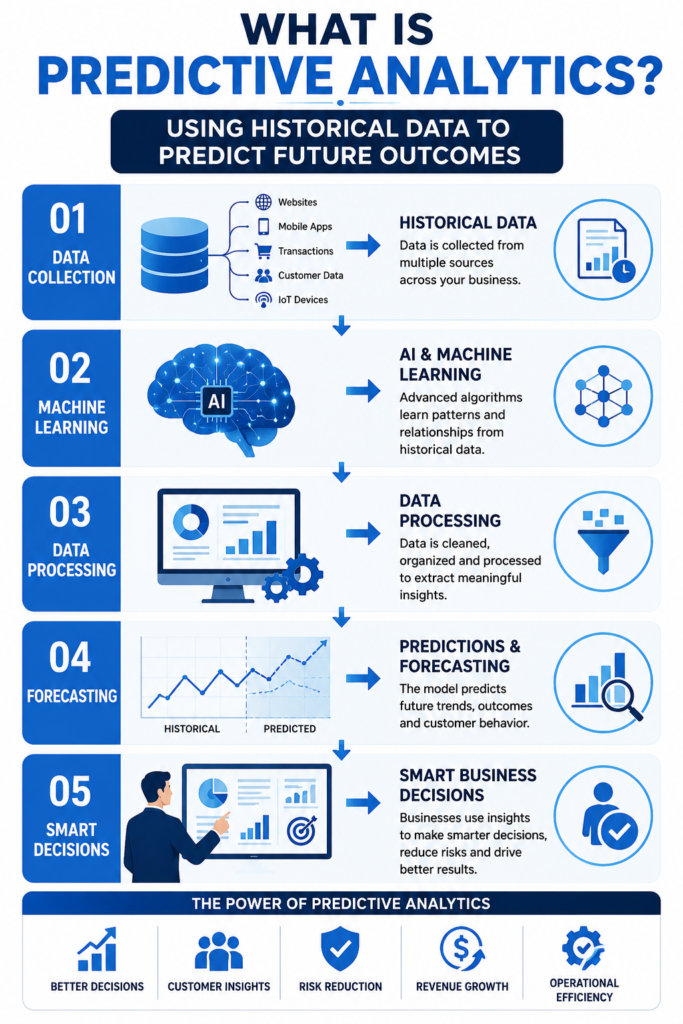
Predictive analytics is the process of analyzing historical and real-time data to forecast future outcomes. It combines several technologies, including:
- Data mining
- Machine learning
- Artificial intelligence
- Statistical modeling
- Big data analytics
The goal is simple: help businesses make smarter, faster, and more accurate decisions.
For example:
- E-commerce platforms predict customer buying behavior.
- Banks identify fraudulent transactions before damage occurs.
- Healthcare organizations forecast patient risks.
- Manufacturing companies predict equipment failures.
- Marketing teams personalize campaigns based on user behavior.
Instead of reacting to problems after they happen, predictive analytics allows businesses to act proactively.
Why Predictive Analytics Matters in Modern Business
The business environment has become highly data-driven. Organizations that fail to use data intelligently often struggle with inefficiency, poor customer experience, and slower decision-making.
Predictive analytics provides several strategic advantages.
Improved Decision-Making
Business leaders can make evidence-based decisions instead of relying only on assumptions or intuition.
For example:
- Sales forecasting becomes more accurate.
- Inventory management improves.
- Customer retention strategies become data-backed.
- Risk assessment becomes more reliable.
As a result, businesses reduce uncertainty and improve operational efficiency.
Better Customer Experience
Customer expectations continue to evolve rapidly. Predictive analytics helps companies understand:
- Customer preferences
- Purchase patterns
- Browsing behavior
- Engagement trends
- Support requirements
This enables businesses to deliver personalized experiences, recommendations, and offers.
Companies like Amazon and Netflix are well-known examples of predictive recommendation systems. According to IBM’s analytics insights, predictive models significantly improve customer engagement and operational performance.
Increased Operational Efficiency
Predictive systems help organizations optimize resources and automate processes.
For instance:
- Logistics companies predict delivery delays.
- IT teams forecast server overloads.
- Manufacturers predict maintenance needs.
- HR departments predict employee turnover.
Consequently, businesses save both time and operational costs.
Competitive Advantage
Businesses using predictive analytics gain deeper market insights and faster adaptability. This helps organizations identify trends before competitors and respond more effectively to market changes.
How Predictive Analytics Works
Understanding the predictive analytics process is important for businesses planning to adopt it successfully.
1. Data Collection
The first step involves gathering data from multiple sources, such as:
- Websites
- CRM systems
- Mobile apps
- IoT devices
- ERP platforms
- Customer databases
- Social media
The quality of predictive insights depends heavily on data quality.
2. Data Cleaning and Preparation
Raw data often contains:
- Missing values
- Duplicates
- Inconsistencies
- Errors
Data scientists clean and structure the information before analysis. This stage is critical because poor-quality data leads to inaccurate predictions.
3. Model Building
Machine learning algorithms and statistical models analyze patterns within the data.
Common predictive models include:
- Regression analysis
- Decision trees
- Neural networks
- Random forests
- Time-series forecasting
These models learn from historical data to identify future probabilities.
4. Validation and Testing
Before deployment, businesses test predictive models to ensure reliability and accuracy.
This process helps identify:
- False predictions
- Model bias
- Performance limitations
5. Deployment and Monitoring
Once validated, predictive models integrate into business systems.
Businesses then continuously monitor performance and retrain models using updated data.
Key Technologies Behind Predictive Analytics
Several advanced technologies power modern predictive analytics systems.
Artificial Intelligence and Machine Learning
AI and machine learning algorithms automate pattern recognition and continuously improve predictions over time.
These technologies allow businesses to process large datasets much faster than traditional analytical methods.
Organizations interested in AI-driven business systems often explore modern technologies similar to those discussed in AI and ML transforming modern business operations.
Big Data Platforms
Predictive analytics relies heavily on big data infrastructure.
Technologies such as:
- Apache Hadoop
- Apache Spark
- Kafka
- Snowflake
enable businesses to process enormous datasets efficiently.
Cloud Computing
Cloud platforms provide scalability and flexibility for predictive analytics implementation.
Popular cloud services include:
- AWS
- Microsoft Azure
- Google Cloud Platform
Cloud computing reduces infrastructure costs while improving processing capabilities.
Data Visualization Tools
Visualization tools help decision-makers understand predictions clearly.
Popular tools include:
- Tableau
- Power BI
- Looker
These dashboards transform complex analytics into understandable business insights.
Real-World Applications of Predictive Analytics
Predictive analytics is transforming multiple industries worldwide.
Retail and E-Commerce
Retailers use predictive analytics to:
- Forecast demand
- Recommend products
- Optimize pricing
- Reduce cart abandonment
- Improve customer retention
For example, recommendation engines analyze browsing history and purchase behavior to suggest relevant products.
Healthcare
Healthcare organizations use predictive analytics for:
- Disease prediction
- Patient monitoring
- Treatment optimization
- Hospital resource planning
According to Microsoft’s healthcare AI insights, predictive technologies are helping improve patient outcomes and operational efficiency.
Banking and Financial Services
Financial institutions use predictive analytics to:
- Detect fraud
- Assess credit risk
- Predict loan defaults
- Automate investment strategies
Real-time fraud detection systems significantly reduce financial losses.
Manufacturing
Manufacturers apply predictive analytics for:
- Predictive maintenance
- Supply chain optimization
- Production forecasting
- Equipment performance monitoring
This minimizes downtime and improves productivity.
Marketing and Advertising
Marketing teams use predictive analytics to:
- Analyze campaign performance
- Identify target audiences
- Personalize advertisements
- Improve conversion rates
Predictive customer segmentation helps businesses create more effective marketing strategies.
Benefits of Predictive Analytics for Businesses
The value of predictive analytics goes beyond forecasting.
Faster Business Growth
Data-driven businesses adapt faster to changing market conditions and customer expectations.
This leads to:
- Better innovation
- Faster scaling
- Improved profitability
Reduced Risks
Predictive systems identify potential problems before they become critical.
Examples include:
- Cybersecurity threats
- Financial fraud
- Equipment failures
- Customer churn
This proactive approach helps businesses reduce costly disruptions.
Smarter Resource Allocation
Predictive insights help businesses allocate:
- Budget
- Workforce
- Inventory
- Infrastructure
more efficiently.
Better Strategic Planning
Executives can use predictive insights for long-term business planning and investment decisions.
This improves organizational stability and scalability.
Challenges Businesses Face with Predictive Analytics
Although predictive analytics offers significant advantages, implementation comes with challenges.
Data Privacy and Security
Businesses must protect customer data and comply with privacy regulations.
Poor data governance can create:
- Security risks
- Compliance issues
- Customer trust problems
Organizations investing in analytics platforms should prioritize cybersecurity strategies and secure application development practices.
Data Quality Problems
Inaccurate or incomplete data can reduce prediction accuracy.
Businesses often struggle with:
- Disconnected systems
- Legacy infrastructure
- Inconsistent datasets
Therefore, proper data management becomes essential.
High Initial Investment
Implementing predictive analytics may require investment in:
- Infrastructure
- Skilled professionals
- Software platforms
- Cloud services
However, long-term benefits often outweigh initial costs.
Lack of Skilled Talent
Many organizations face shortages of:
- Data scientists
- AI engineers
- Analytics specialists
As predictive technologies grow, skilled professionals become increasingly important.
How Businesses Can Successfully Implement Predictive Analytics
Adopting predictive analytics successfully requires a structured approach.
Start with Clear Business Goals
Businesses should first identify specific problems they want to solve.
Examples include:
- Improving customer retention
- Reducing operational costs
- Forecasting sales
- Detecting fraud
Clear objectives improve implementation success.
Invest in Data Infrastructure
Strong data infrastructure forms the foundation of predictive analytics.
Businesses should focus on:
- Cloud storage
- Secure databases
- API integrations
- Data pipelines
Modern enterprises increasingly adopt scalable web and application development solutions to support analytics-driven operations and intelligent automation systems.
Choose the Right Tools and Technologies
Selecting suitable tools depends on business size, budget, and objectives.
Popular predictive analytics platforms include:
- TensorFlow
- Azure Machine Learning
- IBM Watson
- SAS Analytics
- Google Vertex AI
Build Cross-Functional Teams
Successful predictive analytics projects involve collaboration between:
- Developers
- Business analysts
- Data scientists
- Executives
- IT teams
Cross-functional teamwork improves implementation quality.
Continuously Monitor and Improve Models
Predictive models must evolve continuously.
Businesses should:
- Retrain models regularly
- Monitor performance
- Update datasets
- Improve algorithms
Continuous optimization ensures long-term effectiveness.
The Future of Predictive Analytics
Predictive analytics continues to evolve rapidly with advancements in AI and automation.
Future trends include:
Real-Time Predictive Intelligence
Businesses are moving toward real-time analytics systems capable of making instant predictions and automated decisions.
AI-Powered Automation
AI-driven automation will increasingly combine with predictive analytics to create intelligent business workflows.
Edge Analytics
IoT devices and edge computing will allow predictions closer to data sources, reducing latency and improving efficiency.
Hyper-Personalization
Businesses will deliver highly personalized customer experiences using predictive behavioral analysis.
Industry-Specific Predictive Platforms
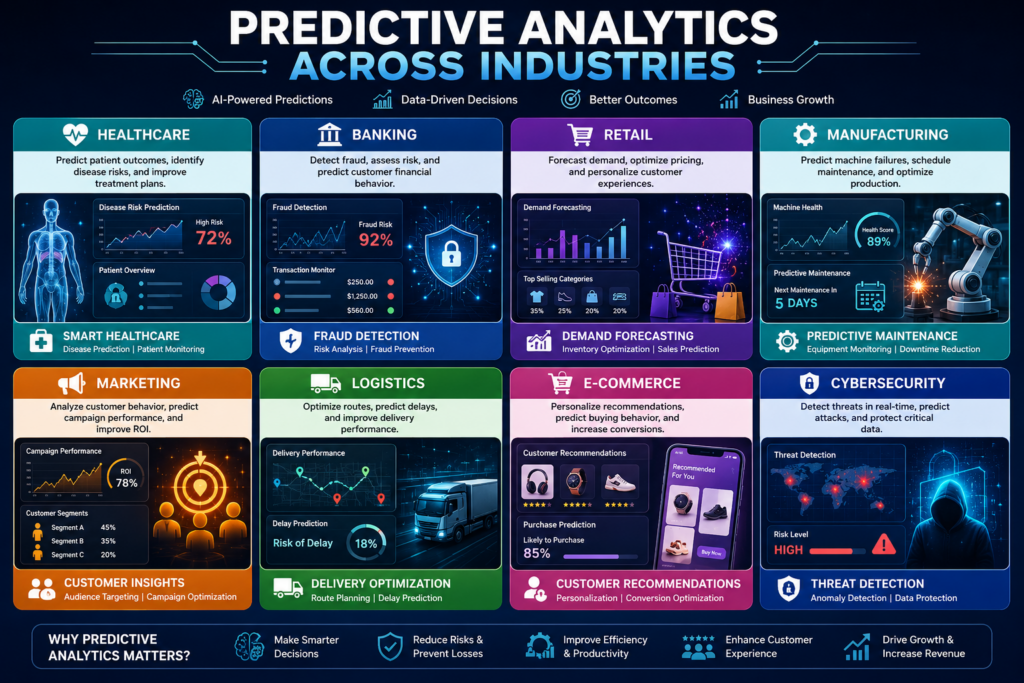
More companies will adopt specialized analytics platforms tailored to industries like healthcare, finance, manufacturing, and retail.
Why Predictive Analytics Is No Longer Optional
In today’s competitive digital landscape, predictive analytics is no longer a luxury reserved for large enterprises. Businesses of all sizes now recognize the importance of data-driven decision-making.
Organizations that fail to leverage predictive analytics may struggle with:
- Inefficient operations
- Poor customer engagement
- Slow decision-making
- Higher risks
- Reduced competitiveness
On the other hand, businesses embracing predictive technologies gain stronger operational intelligence, faster adaptability, and better growth opportunities.
Companies investing in modern digital transformation strategies often integrate predictive analytics alongside AI, automation, cloud computing, and scalable software architecture to build future-ready operations. Businesses looking to modernize their systems can also explore innovative technology insights and digital growth resources shared by platforms like TechDef, which regularly highlight emerging IT trends, automation strategies, and intelligent business solutions.
Companies investing in modern digital transformation strategies often integrate predictive analytics alongside AI, automation, cloud computing, and scalable software architecture to build future-ready operations. Businesses looking to modernize their systems can explore advanced custom IT solutions and digital services that support scalable analytics infrastructure and intelligent business applications.
Conclusion
Predictive analytics is transforming how businesses operate, compete, and grow. By analyzing historical and real-time data, organizations can forecast future outcomes, reduce risks, improve customer experiences, and optimize operations more effectively than ever before.
As artificial intelligence, machine learning, and cloud technologies continue to evolve, predictive analytics will become even more powerful and accessible. Businesses that invest in intelligent data strategies today will be better prepared for tomorrow’s challenges and opportunities.
Whether it is forecasting customer behavior, improving operational efficiency, preventing fraud, or optimizing business performance, predictive analytics empowers organizations to make smarter decisions with greater confidence.
In an increasingly digital world, data is one of the most valuable business assets. However, the true value of data only emerges when businesses can turn it into actionable intelligence — and predictive analytics makes that possible.
Tags
Share this article
About the Author
Experienced IT professional specializing in enterprise solutions and modern technology implementations.
Related Articles
Stay Updated
Get the latest IT insights delivered to your inbox.