
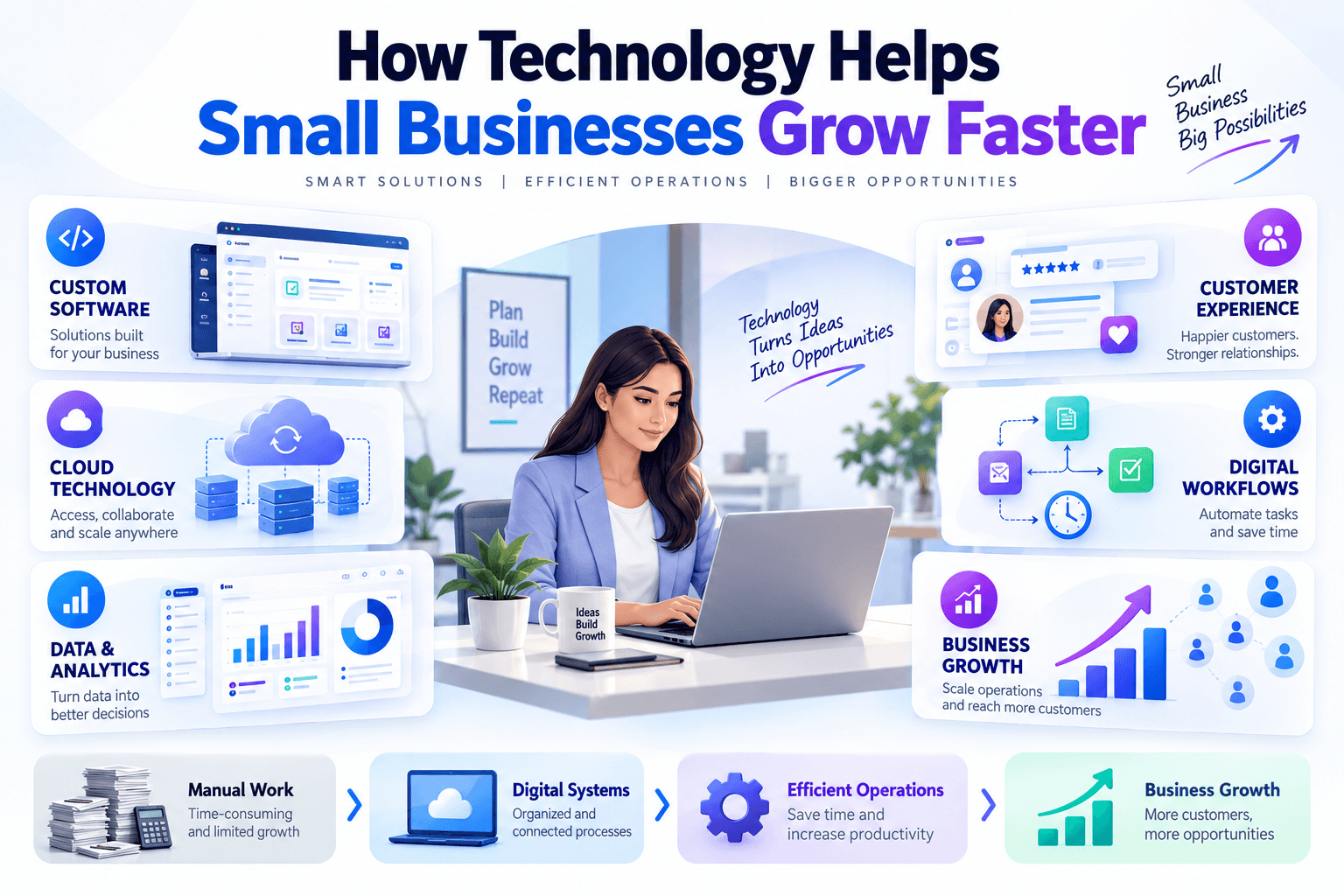
Small businesses often compete with larger organizations that have bigger teams, larger budgets, and more established processes. However, modern technology has significantly reduced that gap. The right digital tools can help a small business operate efficiently, reach customers faster, reduce repetitive work, and make better decisions without requiring enterprise-level resources.
In fact, technology helps small businesses grow faster by improving how they manage customers, operations, marketing, communication, data, and internal workflows. Instead of simply adding more employees as the business grows, companies can use technology to make existing teams more productive.
For businesses that need solutions tailored to their specific workflows, custom IT solutions can provide a practical foundation for digital growth. Rather than forcing a business to adapt completely to a generic application, custom software can be designed around its processes, customers, and long-term goals.
The important point is that technology is not valuable simply because it is new. It becomes valuable when it solves a real business problem.
Why Technology Helps Small Businesses Grow Faster
Growth usually creates new challenges. A company may start with a small team, spreadsheets, email communication, and manual processes. As customers increase, however, those same processes can become difficult to manage.
Technology helps small businesses grow faster by creating more efficient systems for handling this increased workload.
For example, a business might initially track customer inquiries manually. When the number of inquiries increases, employees can spend hours organizing information, following up with prospects, and updating records.
A digital customer management system can centralize this information and make it easier for employees to find what they need.
Similarly, an online ordering system can reduce phone-based orders, while an automated reporting dashboard can replace manually prepared spreadsheets.
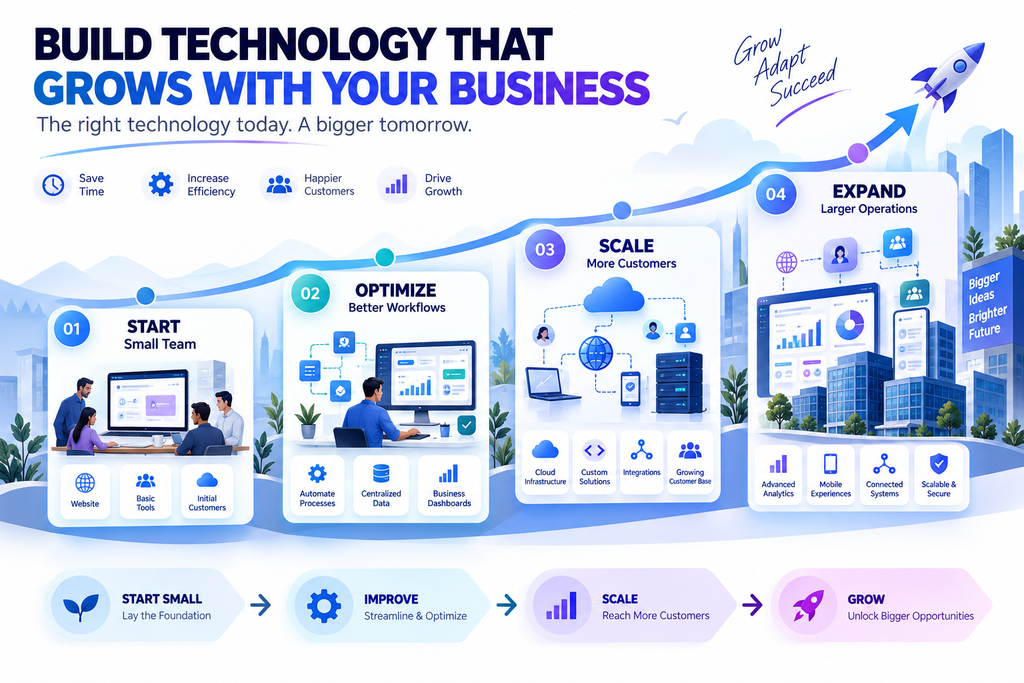
The result is a business that can handle more activity without increasing operational complexity at the same rate.
Technology Creates Operational Efficiency
Efficiency is one of the biggest advantages technology provides to small businesses.
Digital systems can reduce:
- Repetitive administrative work
- Manual data entry
- Paper-based processes
- Communication delays
- Duplicate records
- Human errors
- Time spent searching for information
- Manual reporting
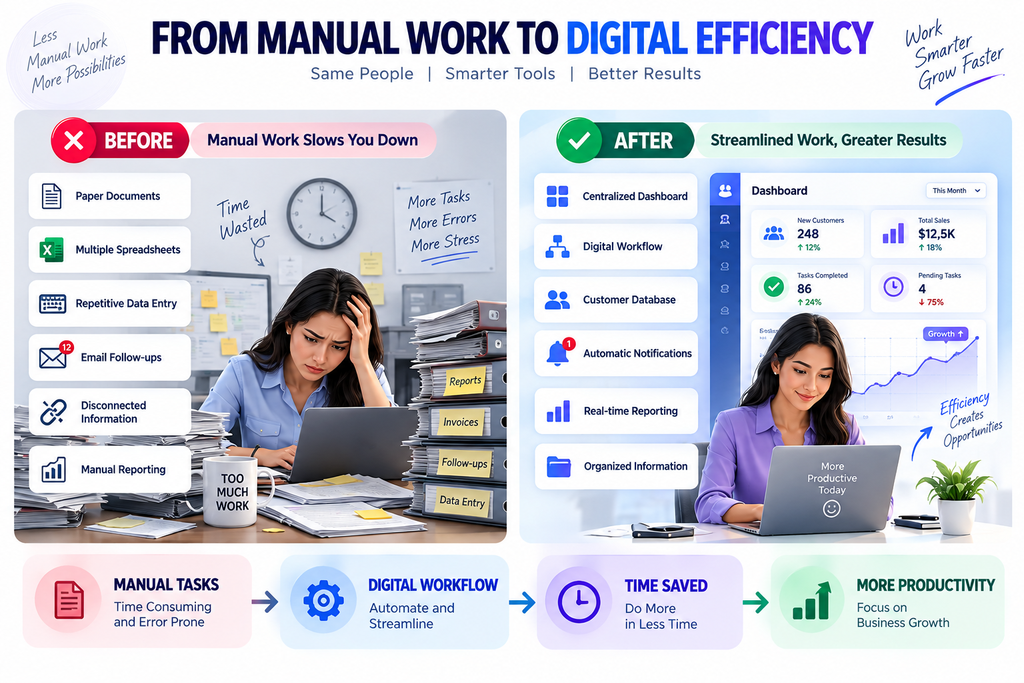
When employees spend less time on repetitive work, they can focus on activities that directly contribute to business growth.
1. Technology Automates Repetitive Business Processes
Many small businesses lose valuable time because employees repeatedly perform the same tasks.
Consider a simple workflow:
- A customer submits an inquiry.
- An employee records the information.
- The employee sends a confirmation.
- Customer details are added to a spreadsheet.
- A follow-up reminder is created.
- Another employee checks the status later.
A properly designed digital system can bring many of these steps into one workflow.
This does not necessarily mean every process needs complex automation. Even a simple web application with centralized records, notifications, dashboards, and user management can make a significant difference.
Examples of Processes That Can Be Digitized
Small businesses can improve efficiency by digitizing processes such as:
- Customer inquiry management
- Appointment scheduling
- Inventory tracking
- Employee task management
- Invoice generation
- Order processing
- Document management
- Customer support
- Internal approvals
- Business reporting
The objective should always be to remove unnecessary friction rather than introduce technology for its own sake.
2. Custom Software Can Solve Business-Specific Problems
Off-the-shelf software can be useful for many businesses. However, generic tools do not always match the way a particular organization operates.
A growing business may eventually encounter situations where employees need to use several disconnected applications to complete one workflow.
For example, customer information may exist in one system, order information in another, and internal reporting in a spreadsheet. Employees then have to move information between platforms.
This creates additional work and increases the possibility of errors.
Custom software can bring these processes together.
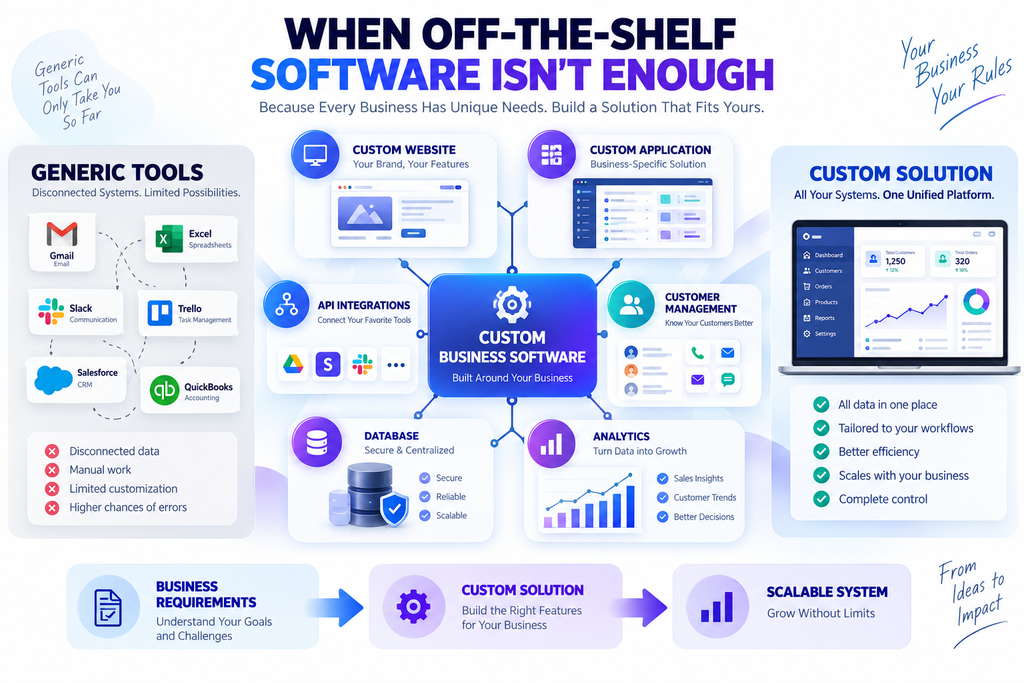
When Should a Small Business Consider Custom Software?
Custom development may be worth considering when:
- Existing software does not support important workflows.
- Employees repeatedly use spreadsheets to compensate for missing features.
- Multiple systems need to exchange information.
- Manual processes are slowing business growth.
- The business requires specialized customer experiences.
- Management needs business-specific reports or dashboards.
- Existing software becomes expensive as the company scales.
A custom web application, for example, can provide exactly the functionality a company requires instead of forcing employees to work around limitations.
3. Technology Improves Customer Experience
Customers increasingly expect businesses to provide fast, convenient, and consistent digital experiences.
A small business can use technology to make customer interactions easier from the first contact through post-sale support.
A professional website can provide essential information 24/7. Online forms can simplify inquiries. Customer portals can provide account information. Digital payment systems can make transactions faster.
According to NIST’s Cybersecurity Framework, organizations should also consider security as part of managing technology and business risk. This is especially important when customer information is collected through digital systems.
A Better Digital Customer Journey
A technology-enabled customer journey might look like this:
Discover → Visit Website → Submit Inquiry → Receive Response → Purchase → Get Support → Return
Each stage provides an opportunity to improve the customer’s experience.
For instance, a well-designed website can answer common questions before a customer contacts the business. A customer management system can help employees respond with relevant information instead of asking customers to repeat their details.
Therefore, technology does not just improve internal operations. It can directly influence customer satisfaction and retention.
4. Technology Helps Small Businesses Reach More Customers
Digital marketing has changed how small companies compete for attention.
A small business no longer needs a massive advertising budget to build an online presence. With a professional website, search engine optimization, social media, email communication, and useful content, businesses can reach highly targeted audiences.
Technology makes this process measurable.
Businesses can analyze:
- Website traffic
- Search performance
- Customer inquiries
- Conversion rates
- Marketing campaigns
- Customer engagement
- Sales sources
This data helps business owners understand which activities generate results.
Websites Become Digital Business Assets
A website should not simply act as an online brochure.
For many businesses, it can become an important business platform that supports:
- Lead generation
- Product sales
- Customer support
- Online bookings
- Content publishing
- Customer accounts
- Payments
- Business communication
As business requirements become more complex, a custom website or web application can provide functionality beyond what a standard website builder offers.
This is one reason businesses often benefit from working with an experienced IT and custom software development provider when their digital requirements become more specialized.
5. Cloud Technology Makes Growth More Flexible
Cloud computing has made sophisticated technology more accessible to smaller organizations.
Instead of maintaining extensive physical infrastructure, businesses can use cloud-based services for hosting, storage, collaboration, databases, backups, and applications.
The National Institute of Standards and Technology (NIST) defines cloud computing around convenient, on-demand access to shared computing resources.
For a small business, this flexibility can be valuable.
Benefits of Cloud-Based Systems
Cloud technology can help businesses:
- Scale resources as demand changes
- Access systems from different locations
- Reduce dependence on physical infrastructure
- Improve collaboration
- Simplify backups
- Deploy applications more efficiently
- Support business continuity
For example, a growing e-commerce company may experience significant changes in website traffic during promotional campaigns. A properly planned cloud infrastructure can provide greater flexibility than relying only on fixed local resources.
6. Data Helps Small Businesses Make Better Decisions
Growing businesses generate increasing amounts of information.
Sales transactions, customer inquiries, website visits, inventory levels, employee activity, and marketing performance can all provide useful insights.
However, collecting data is only the first step.
The real advantage comes from turning data into decisions.
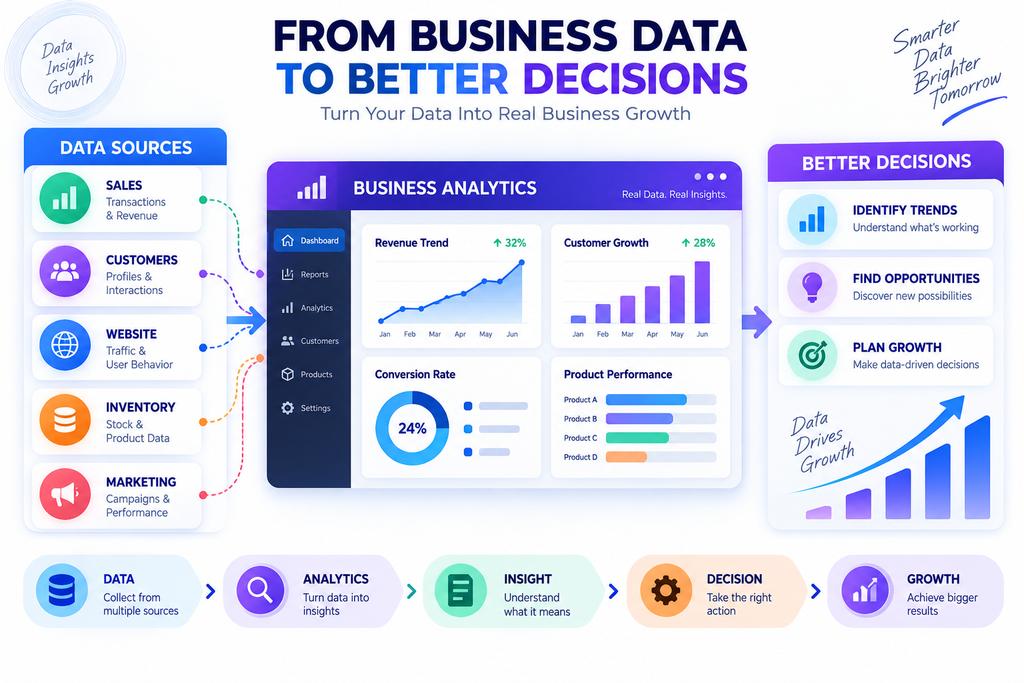
From Guesswork to Business Intelligence
Imagine a business owner wants to know:
Which products generate the highest revenue?
Instead of manually reviewing hundreds of transactions, a digital dashboard could display the information immediately.
Similarly, management could monitor:
- Monthly revenue
- Customer acquisition
- Repeat purchases
- Product performance
- Operating costs
- Conversion rates
- Support requests
This makes decision-making faster and more evidence-based.
A well-designed reporting system can also bring information from multiple parts of the organization into a single view.
7. Technology Improves Team Collaboration
As a company grows, communication becomes more complicated.
A team of three people can often communicate informally. A team of thirty people needs clearer systems.
Technology can provide centralized platforms for tasks, documents, communication, calendars, approvals, and project management.
Instead of asking:
“What is the current status?”
Employees can check the relevant system.
This creates greater transparency and reduces unnecessary communication.
Centralized Information Saves Time
A good digital system should make important information easy to locate.
For example, a project management platform can show:
- Assigned tasks
- Deadlines
- Responsibilities
- Current status
- Project progress
- Outstanding issues
This becomes particularly valuable when multiple departments or teams work together.
8. Technology Helps Reduce Operational Costs
Technology requires investment, but the right technology can reduce long-term operational costs.
Consider an employee who spends ten hours every week preparing reports manually.
If a digital reporting system reduces that work to one hour, the business gains nine productive hours every week.
The same principle applies to many other processes.
Where Cost Savings Can Come From
Technology can reduce costs through:
- Less manual administration
- Fewer data-entry errors
- Reduced paper usage
- Faster customer support
- Better resource allocation
- Improved inventory management
- Faster reporting
- Reduced duplicate work
However, cost reduction should not be the only objective.
A system that saves money but creates a poor customer experience may not provide real business value.
The better approach is to evaluate technology based on time saved, revenue enabled, customer experience, scalability, and operational efficiency.
9. Mobile-Friendly Technology Supports Modern Customers
Customers and employees increasingly interact with businesses through smartphones.
Therefore, mobile responsiveness should be considered an essential part of modern digital experiences.
A responsive website can allow customers to:
- Browse products
- Submit inquiries
- Book appointments
- Make payments
- Access information
- Contact support
Similarly, mobile-friendly internal applications can help employees access relevant business information while working away from their desks.
The goal is not necessarily to build a separate mobile application for every business. In many cases, a responsive website or web application can provide an effective mobile experience.
10. Technology Improves Business Scalability
One of the biggest challenges for small businesses is scaling.
A process that works for 50 customers may not work for 5,000 customers.
Technology provides a way to build systems that can support increasing demand.
For example, a manually maintained customer list might work initially. But as customer numbers increase, the business may need centralized databases, search functionality, customer segmentation, reporting, access controls, and integrations.
Building these capabilities early can make future growth easier.
Build for the Next Stage, Not Just Today
Businesses should avoid both extremes:
Too little technology:
Processes become inefficient and difficult to manage.
Too much technology:
The company spends money on systems it does not actually need.
A better strategy is to identify current bottlenecks and select technology that can grow alongside the organization.
How to Choose the Right Technology for a Small Business
Not every business needs the same digital tools.
Before investing, business owners should evaluate their actual requirements.
Start by asking:
1. What problem are we trying to solve?
Define the problem before selecting the software.
For example:
“Our employees spend too much time manually preparing customer reports.”
is more useful than:
“We need a new business application.”
2. How frequently does the problem occur?
A problem that happens once a month may not justify a major development project.
A problem that affects employees every day could have a significant financial impact.
3. Can existing software solve it?
Before building custom software, investigate whether an existing solution meets the requirements.
If it does, implementation may be faster and more cost-effective.
4. Will the solution scale?
Think beyond the current number of employees and customers.
Consider:
- Future users
- Data growth
- Additional features
- Integrations
- Security requirements
- Reporting needs
5. Can employees use it easily?
Technology only creates value when people actually use it.
A complicated system can create resistance and reduce productivity. Therefore, usability should be treated as an important requirement.
A Practical Technology Growth Strategy
Small businesses do not need to transform everything at once.
A phased approach is often more effective.
Phase 1: Identify Bottlenecks
List the processes that consume the most time.
Look for repetitive tasks, spreadsheets, duplicate data entry, communication problems, and customer service delays.
Phase 2: Prioritize High-Impact Problems
Rank each problem according to:
- Business impact
- Frequency
- Cost
- Customer impact
- Difficulty of solving it
Start with problems that offer clear value.
Phase 3: Select the Right Solution
Depending on the requirement, the solution could be:
- Existing SaaS software
- Cloud services
- Website improvements
- Custom web application
- Mobile application
- API integration
- Business dashboard
- Database solution
Phase 4: Measure Results
After implementation, compare performance before and after the change.
Useful metrics include:
- Time saved
- Cost reduction
- Number of customers served
- Conversion rate
- Response time
- Error rate
- Revenue generated
This turns technology investment into a measurable business decision.
Common Technology Mistakes Small Businesses Should Avoid
Technology can accelerate growth, but poor implementation can have the opposite effect.
Choosing Software Without Defining the Problem
A popular tool is not automatically the right tool.
Start with business requirements.
Ignoring Security
Customer and business data must be protected.
Use appropriate authentication, access controls, backups, secure development practices, and regular updates.
Building Too Many Features
A large application with unnecessary features can become expensive and difficult to maintain.
Start with the features that solve the most important problems.
Forgetting User Experience
Employees and customers should be able to understand the system without unnecessary complexity.
Treating Technology as a One-Time Project
Technology requires ongoing maintenance.
Software should be updated, monitored, secured, and improved as business needs change.
The Future of Small Business Growth Is Digital
Technology is becoming increasingly integrated into everyday business operations.
AI-assisted analysis, cloud platforms, APIs, mobile experiences, cybersecurity solutions, analytics dashboards, and custom applications are changing how companies operate.
However, the fundamental principle remains the same: technology should support business strategy.
A small company does not need every new technology available. It needs the right technology for its customers, employees, processes, and growth objectives.
This is where thoughtful IT planning becomes important. When a business understands its challenges and works with the right technical expertise, technology can become a long-term competitive advantage rather than simply another expense.
For businesses considering a custom digital solution, exploring custom application and website development services can be a useful next step when standard tools no longer fit their operational requirements.
Conclusion
Technology helps small businesses grow faster by making operations more efficient, improving customer experiences, enabling better decisions, reducing repetitive work, and creating systems that can scale with demand.
The biggest advantage is not the technology itself. It is what the technology allows a business to accomplish.
A well-designed website can generate leads around the clock. A custom application can simplify complex workflows. Cloud services can provide flexible infrastructure. Data analytics can improve decision-making. Digital collaboration tools can help teams work more efficiently.
The key is to start with real business problems and choose technology that provides measurable value.
As a small business grows, its technology requirements will naturally evolve. The businesses that continuously improve their digital processes can respond faster, serve customers better, and compete more effectively.
Ultimately, the right technology does more than save time—it creates the foundation for sustainable growth.
For businesses looking to turn technology into a practical growth strategy, working with an experienced IT partner for tailored digital solutions can help bridge the gap between business requirements and scalable technology.
Tags
Share this article
About the Author
Experienced IT professional specializing in enterprise solutions and modern technology implementations.
Related Articles
Stay Updated
Get the latest IT insights delivered to your inbox.