
In today’s fast-paced digital landscape, businesses are under constant pressure to improve efficiency, reduce operating costs, and make better use of their time and resources. One of the most effective ways to achieve these goals is through business task automation.
From startups to large enterprises, organizations handle countless repetitive tasks every day that consume valuable employee time and often slow down productivity. By automating routine processes, businesses can reduce manual effort, minimize errors, improve operational efficiency, and allow teams to focus on innovation, customer experience, and strategic growth initiatives.
As digital transformation continues to reshape industries, companies are increasingly adopting intelligent workflows, automation tools, and custom software solutions to streamline operations. Organizations are leveraging automation across various business functions to simplify operations, improve efficiency, and reduce manual effort. From customer engagement and sales processes to financial management and reporting, automated workflows support more consistent and scalable business operations.
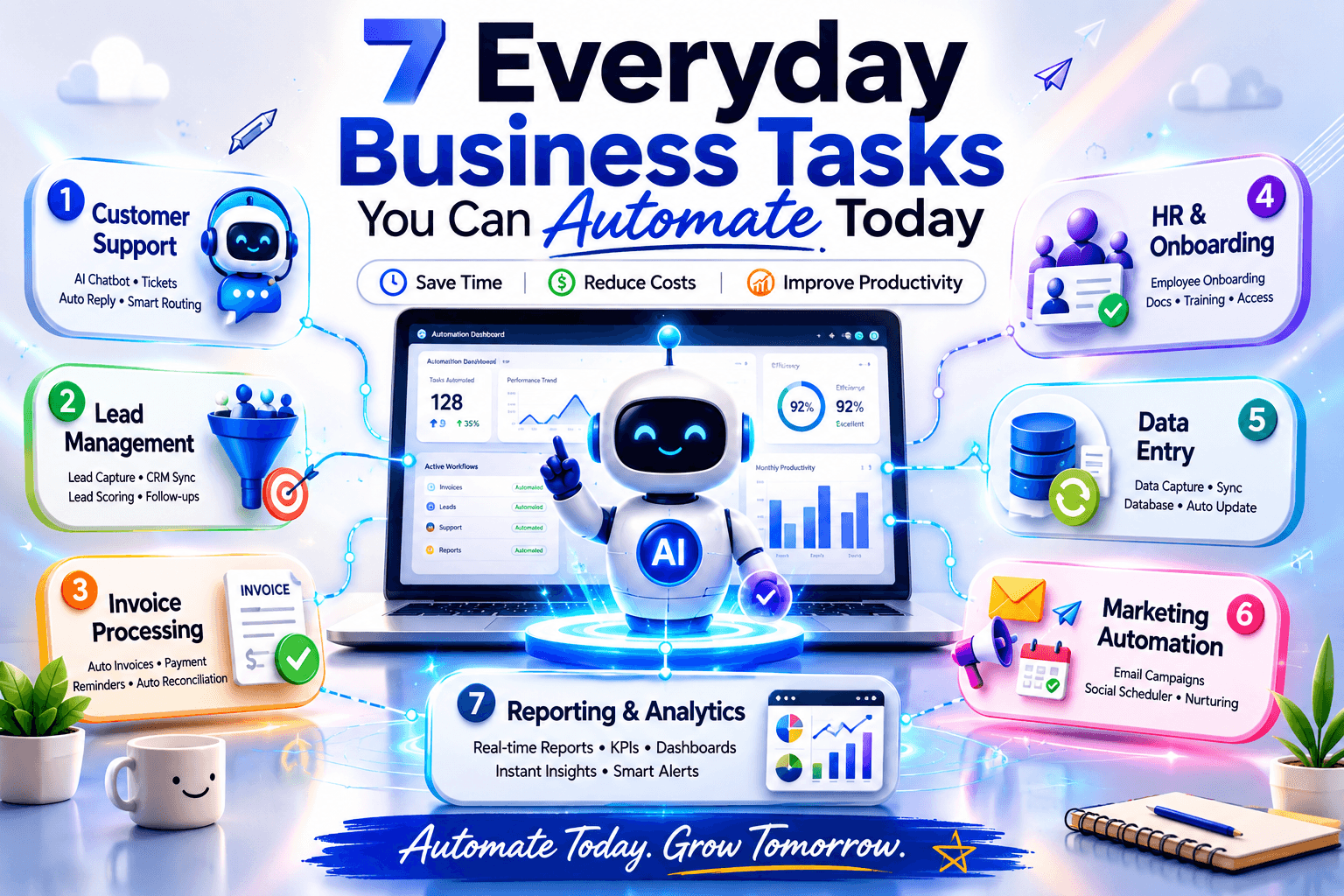
In this article, we’ll explore seven everyday business tasks you can automate today, along with the benefits, tools, and best practices that can help your organization operate more efficiently.
What Is Business Task Automation?
Business task automation can streamline a wide range of routine and operational activities across an organization. From managing customer inquiries and sales leads to processing invoices, organizing data, and handling approval workflows, automation helps businesses improve efficiency, reduce manual effort, and maintain consistent processes at scale.
The primary goals of automation include:
- Saving time
- Reducing manual work
- Improving accuracy
- Enhancing customer experience
- Increasing productivity
- Scaling operations efficiently
Industry research from McKinsey & Company suggests that many routine workplace activities can be automated using existing technologies. This enables organizations to reduce manual workloads, improve productivity, and allow employees to focus on strategic, high-impact initiatives that create greater business value.
Why Businesses Are Investing in Automation
As organizations strive to improve efficiency and remain competitive, automation has evolved from a convenience into a strategic business necessity. Understanding its impact helps businesses identify opportunities for meaningful operational improvements.
Organizations face several challenges:
- Growing customer expectations
- Increased competition
- Rising operational costs
- Limited workforce capacity
- Data management complexity
Automation helps solve these issues by creating standardized processes that operate consistently around the clock.
Some major benefits include:
Increased Productivity
Employees spend less time on repetitive activities and more time on strategic initiatives.
Reduced Human Error
Automated systems follow predefined rules and workflows, reducing mistakes caused by manual data entry or oversight.
Better Customer Experience
Faster response times and consistent service improve customer satisfaction.
Scalability
Automated processes can handle increased workloads without requiring proportional increases in staffing.
1. Customer Support and Inquiry Management
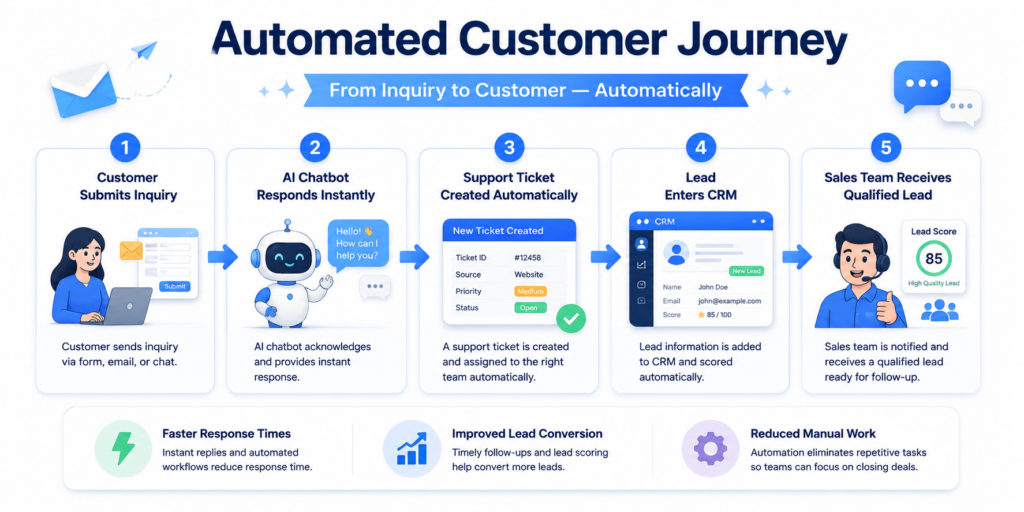
Customer inquiries arrive through multiple channels every day:
- Website forms
- Social media
- Live chat
- Support portals
Managing these requests manually can become overwhelming.
How Automation Helps
Businesses can automate:
- Ticket creation
- Inquiry categorization
- Routing requests to appropriate teams
- Frequently asked questions
- Status updates
- Customer notifications
Customer support automation enables businesses to respond more efficiently by automatically logging requests, assigning tickets, and keeping customers informed throughout the resolution process.
Benefits
- Faster response times
- Improved customer satisfaction
- Reduced workload for support teams
- Better issue tracking
By automating routine customer inquiries and support workflows, businesses can improve response efficiency, reduce operational workload, and deliver a more seamless customer experience across multiple communication channels.
2. Lead Generation and Lead Nurturing
Lead management is one of the most valuable areas for automation.
Automating the Sales Funnel
Businesses can automate:
- Lead capture forms
- Contact database updates
- Lead scoring
- Email follow-ups
- Appointment scheduling
- Sales notifications
Automated lead nurturing workflows can engage prospects immediately after they interact with your business, ensuring timely communication and a more consistent customer journey.
Example Workflow
- Visitor submits form.
- CRM creates a new lead.
- Lead receives welcome email.
- Sales team receives notification.
- Follow-up reminders are scheduled automatically.
Organizations implementing digital customer acquisition strategies often benefit from custom CRM integrations and workflow solutions similar to those discussed in the Technobot System Blog, where technology-driven business improvements are regularly explored.
3. Invoice Processing and Billing
Financial operations involve numerous repetitive tasks that consume administrative resources.
Tasks That Can Be Automated
- Invoice generation
- Payment reminders
- Subscription billing
- Expense tracking
- Receipt management
- Financial reporting
Why It Matters
Automated billing systems help:
- Improve cash flow
- Reduce payment delays
- Eliminate manual calculation errors
- Simplify accounting processes
Automation Example
A service provider can automatically:
- Generate invoices on the first day of each month.
- Send payment reminders after seven days.
- Notify customers about successful payments.
- Update accounting records automatically.
4. Employee Onboarding and HR Processes
Human resources departments often manage numerous repetitive administrative tasks.
Common HR Activities Suitable for Automation
- Employee onboarding
- Document collection
- Leave requests
- Attendance tracking
- Policy acknowledgments
- Performance review reminders
Automating Employee Onboarding
- Welcome emails are sent automatically.
- Required documents are requested.
- Access credentials are generated.
- Training schedules are assigned.
- Team notifications are triggered.
Benefits
- Faster onboarding
- Consistent employee experience
- Reduced administrative effort
- Better compliance tracking
5. Data Entry and Database Management
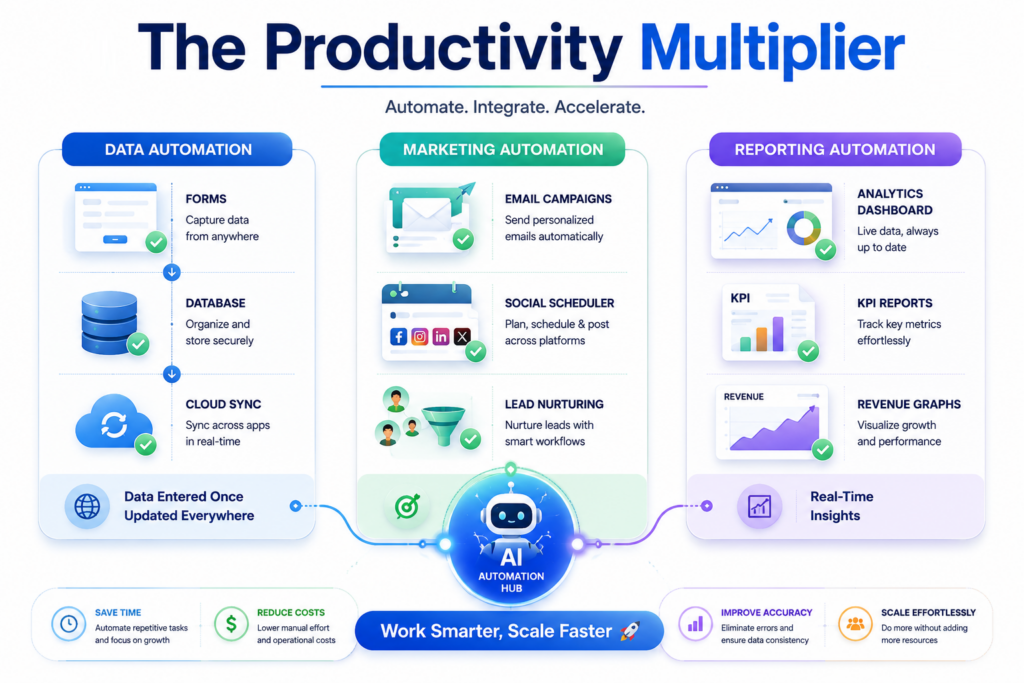
Data is one of the most valuable business assets today.
How Business Task Automation Improves Data Management
Automated systems can:
- Capture form submissions
- Sync information between applications
- Validate records
- Update databases
- Generate reports
Example
A customer places an order:
- Customer data enters the CRM.
- Inventory records update automatically.
- Billing information is generated.
- Shipping notifications are created.
All of this can happen without manual intervention.
Workflow automation helps organizations minimize repetitive data-related tasks, improve information accuracy, and ensure greater consistency across business systems.
6. Marketing Tasks You Can Automate
Across modern organizations, many promotional and customer engagement activities follow predictable workflows that can be streamlined through automation.
Marketing Tasks You Can Automate
- Email campaigns
- Social media scheduling
- Lead nurturing
- Audience segmentation
- Campaign reporting
- Customer engagement workflows
Email Marketing Automation
Businesses can create workflows that automatically send:
- Welcome emails
- Product recommendations
- Abandoned cart reminders
- Customer follow-ups
- Newsletter campaigns
Social Media Scheduling
Advantages
- Consistent communication
- Improved engagement
- Better lead conversion
- Reduced marketing workload
Automation allows marketers to focus more on strategy, content quality, and audience growth.
7. Reporting and Business Analytics
Many business leaders spend hours collecting data from various sources to create reports.
This process is highly repetitive and ideal for automation.
Automating Reporting Processes
Businesses can automate:
- Sales reports
- Financial summaries
- Marketing performance reports
- Customer activity reports
- Operational dashboards
Real-Time Visibility
Automated dashboards provide:
- Live business metrics
- Performance tracking
- KPI monitoring
- Trend analysis
Real-time reporting capabilities provide decision-makers with continuous access to business insights, enabling faster responses to trends, opportunities, and operational challenges.
Example
A dashboard may automatically display:
- Revenue growth
- Customer acquisition rates
- Marketing ROI
- Support ticket trends
- Product performance metrics
This enables faster and more informed decision-making.
How to Choose the Right Automation Opportunities
Not every process should be automated immediately.
High Volume
Tasks performed frequently offer the greatest automation benefits.
Rule-Based Activities
Processes with clear steps are easier to automate.
Time-Consuming Tasks
Prioritize activities consuming significant employee time.
Measurable Impact
Focus on processes where results can be tracked and quantified.
Common Automation Mistakes to Avoid
Automating Broken Processes
Never automate an inefficient process without improving it first.
Lack of Employee Training
Employees should understand how automated systems work and how to manage exceptions.
Ignoring Security
Automation often involves sensitive business data.
Strong security controls, access management, and compliance measures are essential.
Over-Automation
Not every customer interaction should be automated.
Human involvement remains critical for complex decisions and relationship building.
The Future of Business Task Automation
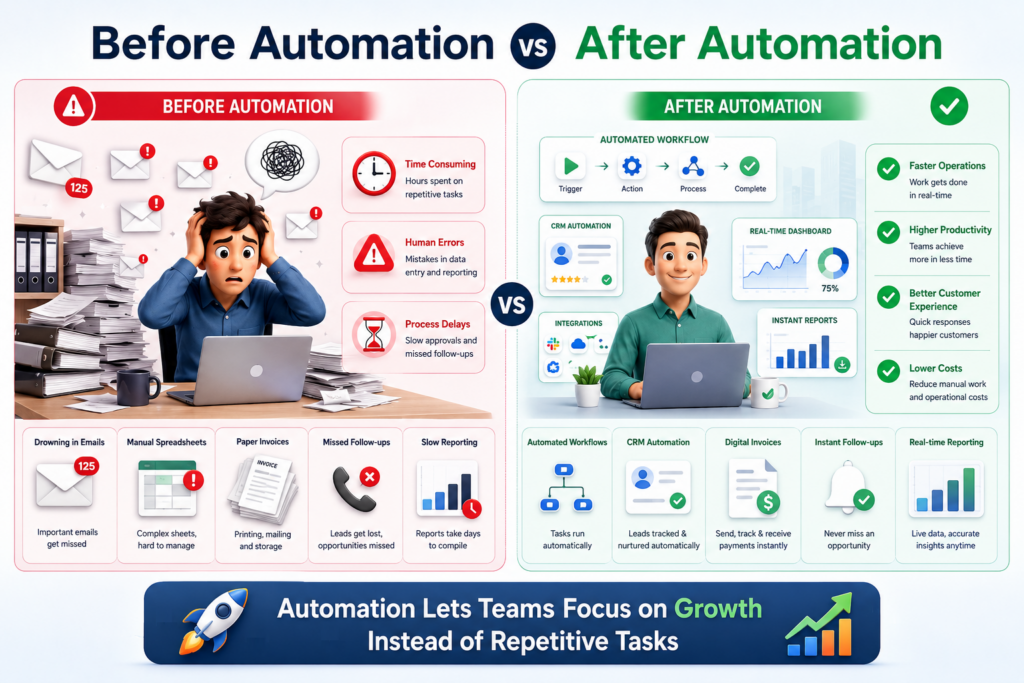
Automation is rapidly evolving beyond traditional workflows.
Emerging technologies include:
- Artificial Intelligence
- Machine Learning
- Predictive Analytics
- Intelligent Document Processing
- Conversational AI
- Robotic Process Automation (RPA)
Businesses that invest early in automation are positioning themselves for greater efficiency and long-term competitiveness.
Every organization has unique workflows, goals, and operational requirements that may not be fully supported by standard software products. Tailored technology solutions provide greater flexibility and can be designed around specific business processes. As their operational needs evolve, many businesses invest in custom software solutions that enhance efficiency, support future growth, and streamline critical business processes.
Conclusion
The benefits of business task automation extend far beyond saving time. Organizations that automate routine processes can improve accuracy, enhance customer experiences, reduce operational costs, and create more scalable business models.
The seven everyday business tasks you can automate today include:
- Customer support management
- Lead generation and nurturing
- Invoice processing and billing
- Employee onboarding and HR workflows
- Data entry and database management
- Marketing campaign management
- Reporting and analytics
As automation technologies continue to evolve, businesses that adopt these solutions early are often better positioned to improve efficiency, scale operations, and remain competitive in a rapidly changing market. Successful automation initiatives typically begin with processes that offer clear business value, measurable outcomes, and opportunities for immediate improvement.
Automation enables organizations to optimize workflows, improve operational accuracy, and utilize resources more effectively. With repetitive tasks handled through automated processes, teams gain additional time to focus on strategic initiatives, customer engagement, and sustainable business growth.
Tags
Share this article
About the Author
Experienced IT professional specializing in enterprise solutions and modern technology implementations.
Related Articles
Stay Updated
Get the latest IT insights delivered to your inbox.