
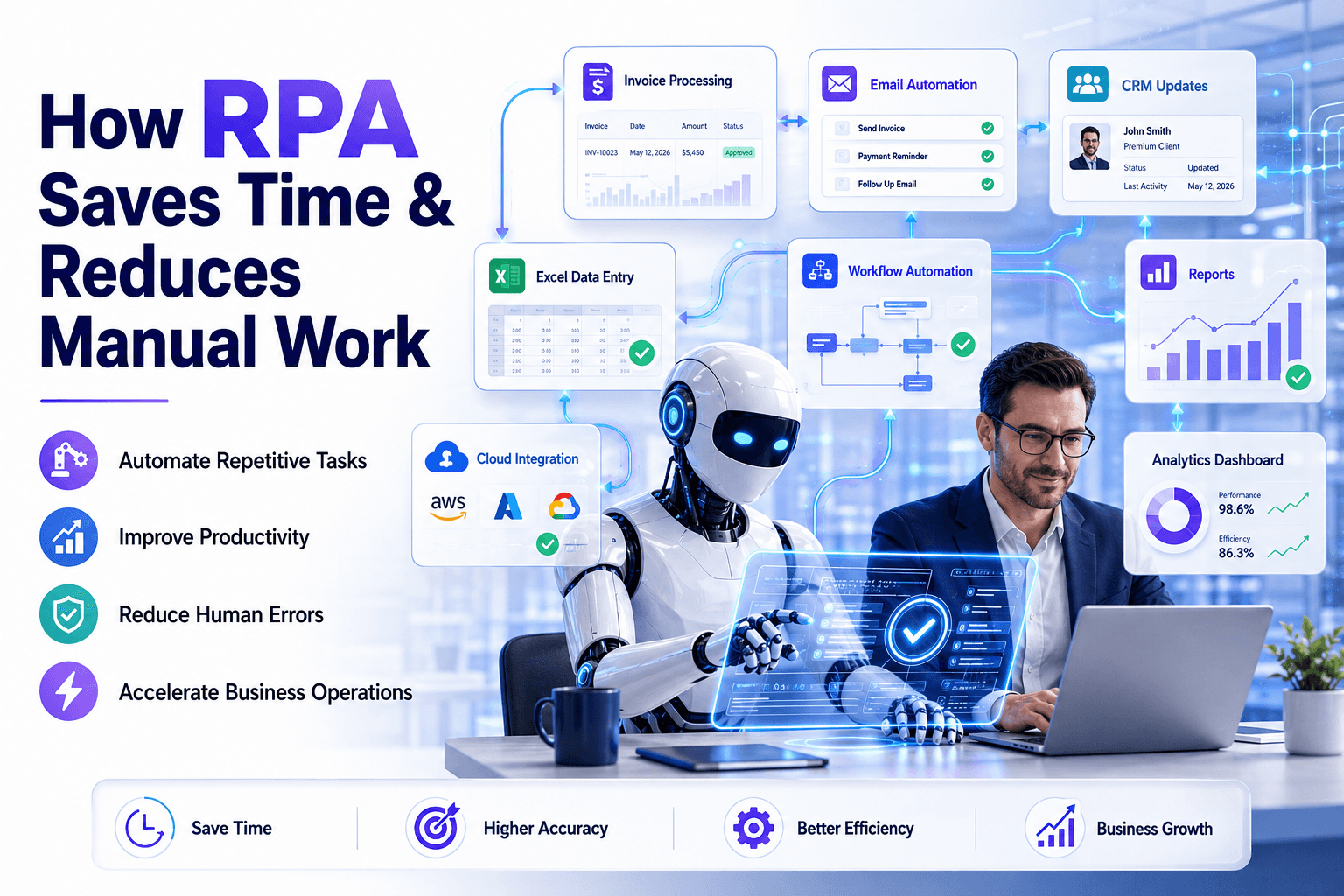
Automation has become a key driver of digital transformation, helping organizations improve productivity while reducing operational costs. Among the many automation technologies available today, Robotic Process Automation (RPA) stands out as one of the most practical solutions for businesses looking to streamline repetitive work without replacing existing systems.
Organizations across industries spend thousands of hours every year performing repetitive administrative tasks such as entering data, processing invoices, updating customer records, generating reports, and validating information across multiple applications. While these tasks are essential, they often consume valuable employee time that could otherwise be invested in strategic decision-making, innovation, or customer engagement.
How RPA saves time and reduces manual work has therefore become an important topic for business leaders, IT professionals, and developers alike. By automating routine business processes, RPA enables organizations to increase efficiency, minimize human error, improve compliance, and accelerate business operations.
As businesses continue embracing digital transformation, many organizations also explore custom automation strategies through professional IT development partners. Businesses implementing tailored enterprise software solutions often combine automation with custom applications to maximize operational efficiency. Organizations looking to modernize their workflows frequently explore services such as custom software development available through Technobot System to build scalable digital solutions that complement automation initiatives.
In this article, we’ll explore how RPA works, why it saves significant time, where it delivers the highest value, and how organizations can successfully implement it.
What is Robotic Process Automation (RPA)?
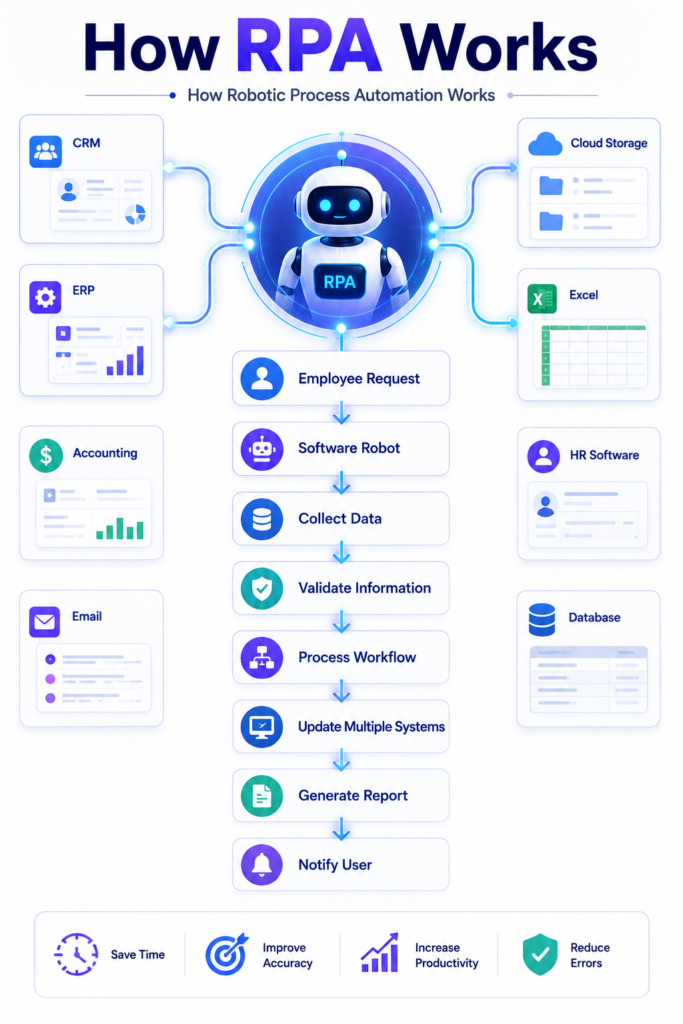
Robotic Process Automation (RPA) is a technology that uses software robots, commonly called “bots,” to automate repetitive, rule-based digital tasks traditionally performed by humans.
Unlike artificial intelligence, traditional RPA follows predefined rules to complete structured workflows. It interacts with applications just as a human would by:
- Clicking buttons
- Opening applications
- Copying and pasting information
- Filling forms
- Reading spreadsheets
- Sending emails
- Generating reports
- Updating databases
Rather than replacing employees, RPA acts as a digital workforce that handles repetitive operations continuously without fatigue.
Because RPA works across existing software platforms, businesses often deploy it without replacing their current systems, making implementation faster and more cost-effective.
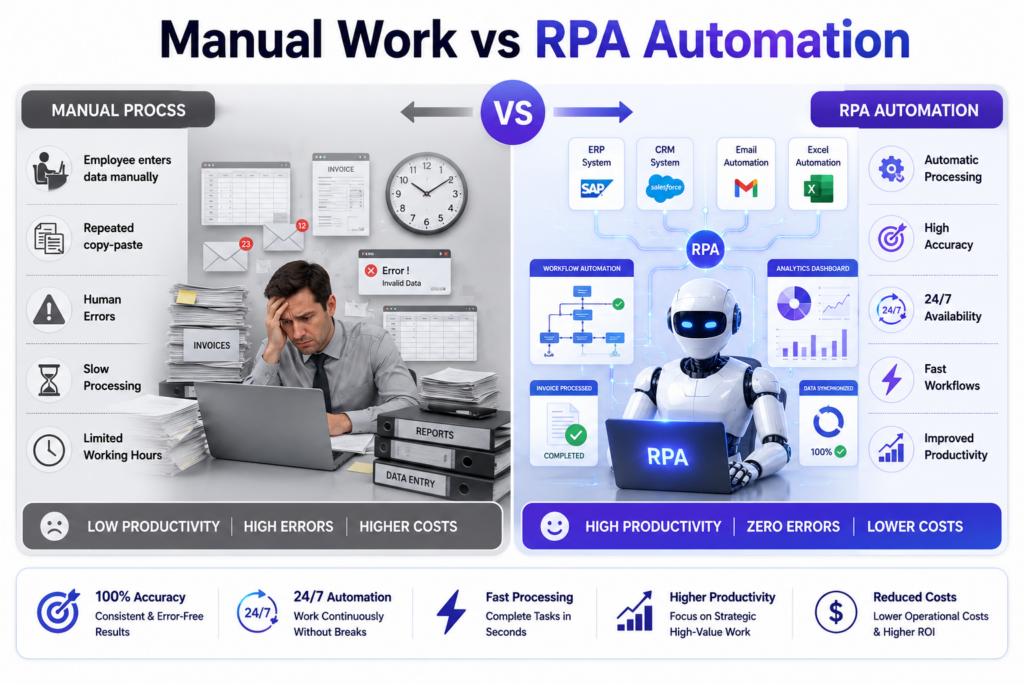
How RPA Saves Time and Reduces Manual Work
Understanding how RPA saves time and reduces manual work starts with identifying where employees spend most of their working hours.
Many business processes involve repetitive activities that require little judgment but consume significant time. RPA automates these tasks, allowing employees to focus on higher-value responsibilities.
Some examples include:
- Data migration
- Payroll processing
- Employee onboarding
- Customer record updates
- Invoice processing
- Order management
- Compliance reporting
- Email notifications
Instead of spending several minutes completing each transaction manually, bots can perform the same work in seconds while maintaining consistency.
Eliminates Repetitive Data Entry
Manual data entry remains one of the biggest productivity challenges in many organizations.
Employees frequently transfer information between:
- CRM systems
- ERP platforms
- Accounting software
- HR applications
- Excel spreadsheets
- Internal databases
These repetitive activities add little strategic value while increasing the risk of human error.
RPA bots automatically collect data from one system and populate another with exceptional accuracy.
For example:
Instead of an employee copying customer information from email attachments into multiple business systems, an RPA bot can complete the process instantly.
Benefits include:
- Faster processing
- Reduced errors
- Improved productivity
- Better employee satisfaction
Reduces Human Errors
Even experienced employees occasionally make mistakes during repetitive tasks.
Common errors include:
- Incorrect data entry
- Missing records
- Duplicate information
- Calculation mistakes
- Formatting inconsistencies
These errors often result in:
- Customer dissatisfaction
- Financial losses
- Compliance risks
- Additional correction work
Since RPA follows predefined rules consistently, software bots execute tasks accurately every time.
This significantly improves data quality across the organization.
Increases Operational Speed
One of the biggest advantages of RPA is speed.
Unlike humans, bots can work:
- 24/7
- Without breaks
- Without interruptions
- Without fatigue
Processes that previously required several hours may now complete within minutes.
For example:
Invoice approvals that traditionally required multiple employees can be processed automatically, reducing turnaround time while improving vendor relationships.
Improves Employee Productivity
Automation is not about replacing employees.
Instead, it removes repetitive work so employees can focus on tasks requiring:
- Creativity
- Critical thinking
- Customer interaction
- Strategic planning
- Innovation
When repetitive work is automated, teams become more productive and engaged.
Organizations often notice higher employee satisfaction because workers spend less time on monotonous activities.
Enhances Customer Experience
Customers expect:
- Faster responses
- Accurate information
- Quick issue resolution
Manual processes often delay customer service.
RPA enables businesses to:
- Process requests instantly
- Update customer information automatically
- Send notifications quickly
- Reduce response times
As a result, customers receive better service while employees handle more meaningful interactions.
Supports Business Scalability
As organizations grow, transaction volumes increase.
Without automation, businesses typically need to hire additional employees to manage increasing workloads.
RPA allows companies to scale operations efficiently by handling thousands of transactions simultaneously.
Instead of expanding administrative teams significantly, businesses can automate routine workflows while employees focus on business growth.
This makes automation especially valuable for growing startups and enterprises alike.
Improves Compliance and Audit Readiness
Industries such as finance, healthcare, insurance, and banking operate under strict regulatory requirements.
Manual processes often create compliance challenges because documentation may be inconsistent.
RPA helps organizations by:
- Recording every action
- Creating audit trails
- Following predefined business rules
- Maintaining consistent documentation
This improves governance while reducing compliance risks.
For best practices on automation governance and intelligent automation trends, organizations can also refer to resources published by IBM at and Microsoft’s Power Automate documentation at, both of which provide valuable guidance on enterprise automation strategies.
Common Business Processes Suitable for RPA
Many industries successfully implement RPA across different departments.
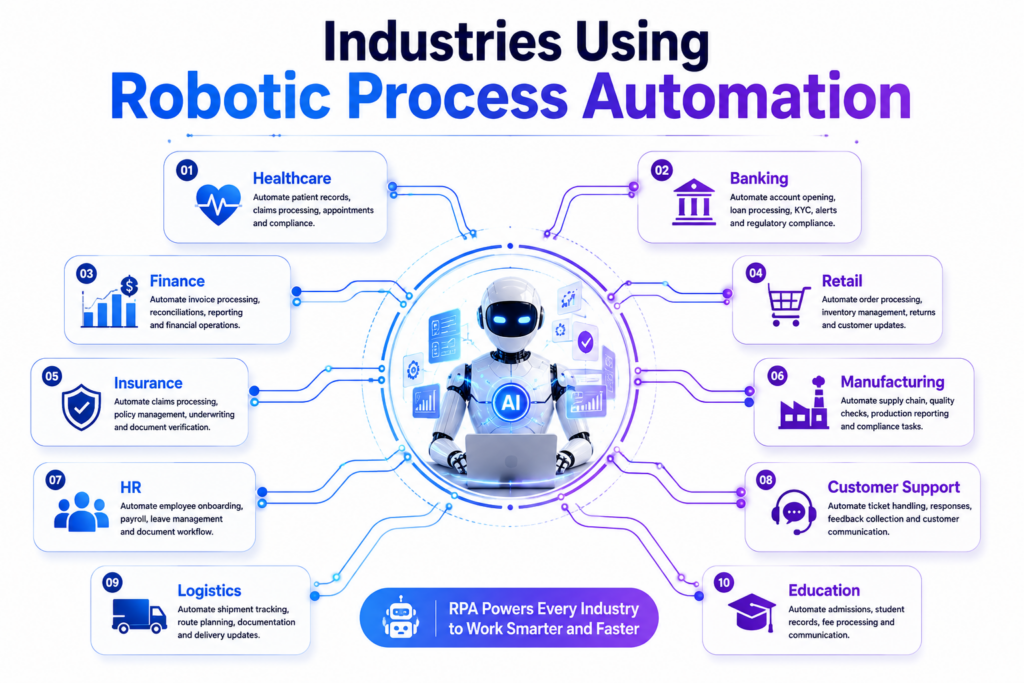
Finance
- Invoice processing
- Expense approvals
- Payment reconciliation
- Financial reporting
Human Resources
- Employee onboarding
- Payroll processing
- Leave management
- Document verification
Customer Support
- Ticket creation
- Status updates
- Customer notifications
- Feedback collection
Healthcare
- Appointment scheduling
- Patient record management
- Claims processing
- Billing automation
Retail
- Inventory updates
- Order processing
- Shipment tracking
- Product catalog management
Banking
- Loan processing
- KYC verification
- Account opening
- Fraud detection support
Many organizations implementing these workflows also invest in tailored digital platforms to integrate automation with existing operations. Businesses evaluating enterprise modernization often benefit from exploring custom application development services and technology insights available through the Technobot System Blog, where topics around digital transformation, automation, and software development are regularly discussed.
Key Benefits of RPA for Businesses
Significant Cost Savings
Automation reduces operational costs by minimizing manual labor while improving process efficiency.
Higher Accuracy
Bots execute tasks consistently according to predefined rules.
Faster Decision Making
Reports become available more quickly because data processing is automated.
Better Resource Utilization
Employees focus on innovation rather than repetitive administrative work.
Improved Customer Satisfaction
Faster processing leads to quicker customer service.
Increased Productivity
Businesses complete more work without proportionally increasing workforce size.
Real-World Example
Consider an insurance company processing thousands of claims daily.
Without automation:
- Employees manually collect documents.
- Verify customer information.
- Enter policy details.
- Approve claims.
- Send confirmation emails.
Each claim may require 20–30 minutes.
With RPA:
Software bots automatically:
- Retrieve customer records
- Validate documents
- Update internal systems
- Generate reports
- Notify customers
Processing time drops dramatically while accuracy improves.
Employees now focus on complex claims requiring human judgment.
Challenges of RPA Implementation
Although RPA offers numerous benefits, successful implementation requires planning.
Common challenges include:
Poor Process Selection
Not every business process is suitable for automation.
Organizations should prioritize repetitive, rule-based tasks.
Lack of Process Standardization
Inconsistent workflows reduce automation efficiency.
Businesses should first standardize processes before automating them.
Change Management
Employees may initially worry about automation.
Clear communication helps demonstrate that RPA supports employees rather than replacing them.
Maintenance
Business rules evolve over time.
Automation workflows require periodic updates to remain effective.
Best Practices for Successful RPA Adoption
Organizations can maximize automation success by following several proven strategies.
Identify High-Volume Tasks
Start with repetitive processes offering immediate productivity gains.
Define Clear Objectives
Measure:
- Time savings
- Cost reduction
- Error reduction
- Productivity improvements
Monitor Performance
Track automation metrics continuously.
Integrate with Existing Systems
Ensure RPA works seamlessly alongside existing enterprise software.
Continuously Improve
Automation should evolve as business processes change.
Organizations planning broader digital transformation initiatives often combine automation with custom software, cloud solutions, and workflow optimization. Working with experienced software development providers such as Technobot System’s custom software services can help businesses design scalable technology ecosystems that support long-term automation goals.
The Future of RPA
The future of RPA extends beyond simple task automation.
Modern automation increasingly combines RPA with:
- Artificial Intelligence
- Machine Learning
- Natural Language Processing
- Intelligent Document Processing
- Predictive Analytics
This combination enables organizations to automate increasingly complex business processes.
As AI technologies mature, businesses will adopt intelligent automation capable of handling both structured and semi-structured workflows with greater efficiency.
Conclusion
Understanding how RPA saves time and reduces manual work is essential for organizations seeking higher efficiency, lower operational costs, and improved business performance. By automating repetitive, rule-based processes, RPA enables businesses to reduce errors, accelerate workflows, strengthen compliance, and free employees to focus on strategic, customer-centric work.
Whether an organization is beginning its automation journey or expanding existing digital initiatives, success depends on selecting the right processes, implementing scalable solutions, and continuously improving workflows. When combined with custom software development, cloud technologies, and thoughtful process design, RPA becomes a powerful foundation for long-term digital transformation.
As automation continues to evolve alongside artificial intelligence, businesses that invest in modern workflow optimization today will be better positioned to compete, innovate, and deliver exceptional customer experiences in the years ahead.
Tags
Share this article
About the Author
Experienced IT professional specializing in enterprise solutions and modern technology implementations.
Related Articles


Stay Updated
Get the latest IT insights delivered to your inbox.