
Businesses today operate in a highly competitive digital environment. Customers expect faster service, employees need efficient tools, and business leaders want accurate information to make better decisions. As a result, software has become much more than a supporting technology. It is now an important part of how modern companies operate and grow.
For many years, businesses relied on ready-made software to manage sales, customer relationships, accounting, communication, inventory, and daily operations. These solutions can still be useful, especially for standard requirements. However, as businesses become more specialized, they often discover that generic software cannot fully support the way they work.
This is one of the main reasons custom software is becoming increasingly attractive.
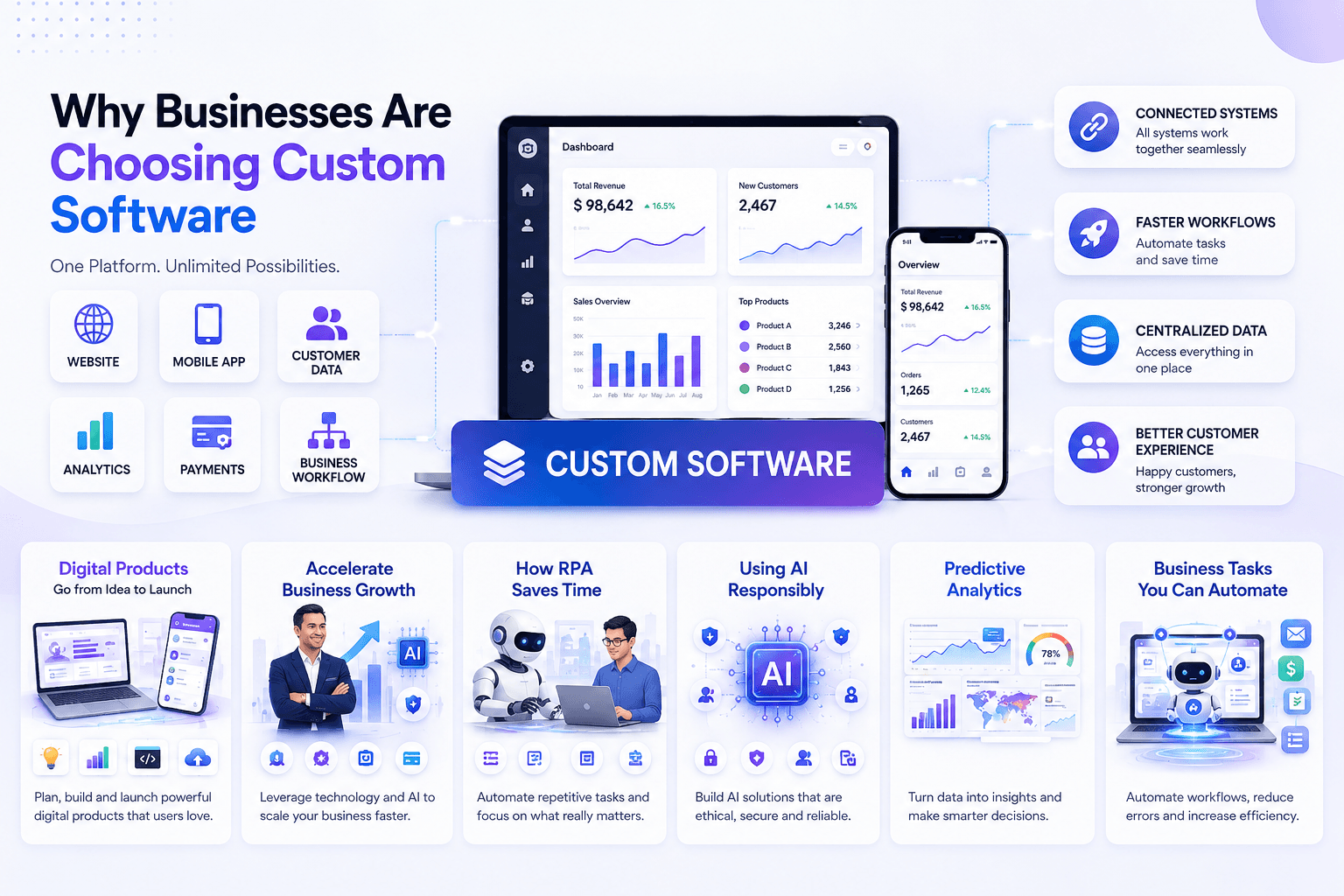
Custom software is designed around a company’s specific processes, requirements, users, and long-term objectives. Instead of forcing a business to adapt its operations to an existing application, custom development allows the software to be built around the business.
Companies exploring this approach can also work with specialized IT service providers such as Technobot System to develop tailored software solutions, custom applications, websites, and other digital products based on their operational needs.
But why are more businesses making this shift? The answer goes beyond simply wanting a better-looking application. Custom software can help businesses improve efficiency, integrate systems, control data, deliver better customer experiences, and create technology that can evolve as the organization grows.
What Is Custom Software?
Custom software is a software application developed specifically for a particular business, organization, or use case.
Unlike off-the-shelf software, which is created for a broad market, custom software focuses on a specific set of business requirements.
For example, a company may need a platform that combines:
- Customer management
- Internal workflow management
- Inventory tracking
- Employee dashboards
- Payment processing
- Reporting and analytics
- Third-party integrations
- Role-based access
- Automated notifications
- Custom business rules
A standard application may provide some of these features, but it may not support the exact workflow the company follows.
With custom software development, those requirements can become part of the application’s architecture from the beginning.
This does not mean every company needs a completely new platform. Sometimes, a custom web application, mobile application, internal dashboard, API integration, or specialized business module can solve the problem more effectively.
The important difference is flexibility.
Why More Businesses Are Choosing Custom Software
The growing adoption of custom software is closely connected to the changing expectations of modern businesses. Companies are no longer competing only on products and prices. They are also competing on speed, convenience, customer experience, operational efficiency, and their ability to respond to market changes.
Here are some of the biggest reasons businesses are moving toward customized solutions.
1. Better Fit for Business Processes
Every organization has its own way of working.
Two companies in the same industry may have completely different approval processes, customer journeys, reporting requirements, pricing structures, or internal workflows.
Off-the-shelf software usually provides predefined workflows. Businesses may need to change their processes to match those workflows.
Custom software takes the opposite approach.
The development process begins by understanding how the organization actually works. Developers can then design features and workflows around those requirements.
This can reduce unnecessary steps and make daily operations more efficient.
For example, instead of employees entering the same information into several systems, a custom application could connect different processes through a single interface.
2. Greater Operational Efficiency
Efficiency is one of the strongest reasons businesses invest in technology.
When employees regularly perform repetitive tasks, search through multiple systems, manually transfer information, or create reports from different data sources, valuable working hours can be lost.
Custom software can address these inefficiencies by creating workflows designed specifically for the organization.
A customized system might:
- Centralize important information
- Reduce duplicate data entry
- Create role-specific dashboards
- Connect multiple business systems
- Simplify approval processes
- Generate reports automatically
- Provide real-time operational information
The result is not simply “more software.” It is a better way of performing business activities.
Custom Software Can Improve Customer Experience
Customer expectations have changed significantly with digital services.
People expect websites and applications to be fast, convenient, responsive, and easy to use. Businesses that provide a complicated customer journey can quickly lose potential customers.
Custom software allows organizations to design experiences around their specific customers.
For example, a business could develop a customer portal where users can:
- Create an account.
- View their information.
- Submit requests.
- Track progress.
- Make payments.
- Receive updates.
- Contact support.
Instead of making customers navigate several disconnected systems, the company can create a more consistent digital experience.
This is particularly valuable for businesses whose customer journey is different from the standard process supported by popular software products.
3. Custom Software Provides Greater Flexibility
One of the biggest limitations of generic software is that businesses have to work within the product’s existing capabilities.
Custom software offers significantly more flexibility.
If the company introduces a new service, changes its workflow, adds a new department, or requires a new integration, the application can potentially be updated to support the change.
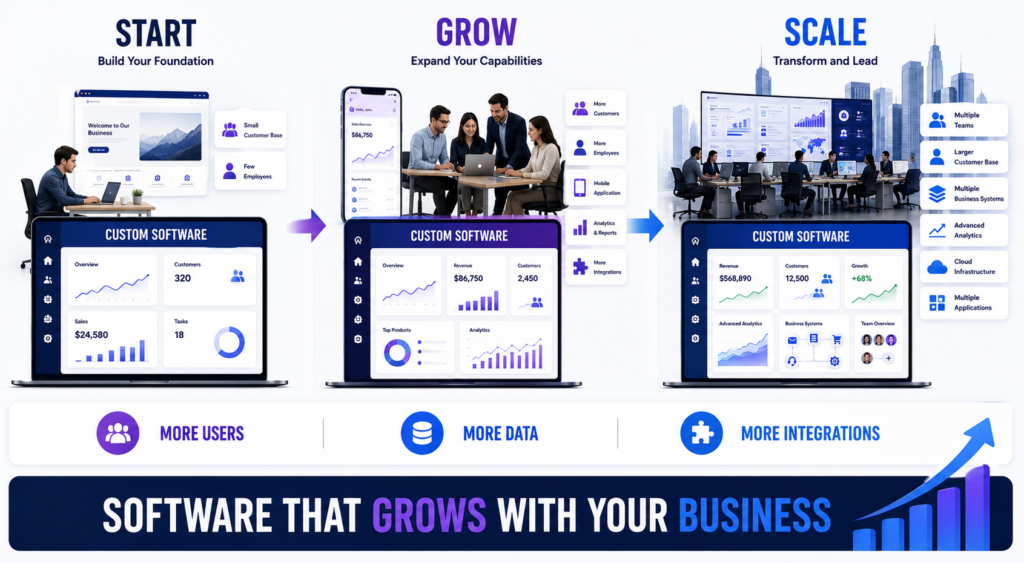
This flexibility is especially important for growing businesses.
A system that works for ten employees may not work efficiently for 100 employees. Similarly, a simple workflow may become complicated as the organization expands.
A customized platform can be designed with future requirements in mind.
Scalability Matters
Scalability means the software can continue supporting the business as its workload and requirements increase.
A scalable application can potentially accommodate:
- More users
- More customers
- Larger data volumes
- Additional locations
- New services
- New integrations
- More complex workflows
This is why businesses should consider long-term requirements when evaluating software rather than focusing only on today’s needs.
4. Better Integration With Existing Systems
Modern organizations rarely use only one software platform.
A business may use separate systems for:
- Accounting
- CRM
- Marketing
- Payments
- Human resources
- Inventory
- Customer support
- Communication
- Analytics
When these systems cannot communicate effectively, employees may have to manually move information between them.
Custom software can act as a central application or integration layer that connects different technologies.
For example, an e-commerce business could connect its website with inventory management, payment processing, customer records, and shipping systems.
This can reduce data duplication and create a more connected technology environment.
For organizations interested in understanding broader software and technology solutions, industry and technology resources on Stacklist can also provide useful context when evaluating technology providers and development approaches.
5. Greater Control Over Data
Data has become one of the most valuable assets for modern organizations.
Businesses collect information from customers, employees, transactions, websites, applications, and internal systems. Managing that information securely and efficiently is therefore essential.
Custom software can provide greater control over how business data is collected, stored, accessed, and displayed.
Organizations can define:
- User roles
- Access permissions
- Data visibility
- Authentication requirements
- Reporting access
- Administrative controls
- Data workflows
Security still depends on proper architecture, development practices, hosting, monitoring, and ongoing maintenance. However, custom development gives businesses more control over how these requirements are incorporated into the system.
The OWASP Foundation is also a valuable resource for organizations and developers looking to understand application security risks and secure software development practices.
6. Custom Software Can Support Competitive Advantage
Software can become a strategic business asset.
When competitors use similar off-the-shelf products, organizations can differentiate themselves through unique digital processes and experiences.
Consider two businesses offering similar services.
One uses a standard platform with limited customization. The other develops a digital system specifically around its customers and internal operations.
The second company may be able to:
- Respond to customers faster
- Provide specialized features
- Analyze its business data more effectively
- Adapt workflows more quickly
- Introduce new services faster
The software itself does not automatically create competitive advantage. The advantage comes from how effectively technology supports the company’s strategy.
7. Businesses Can Avoid Unnecessary Features
Off-the-shelf software often includes dozens or even hundreds of features.
While having many features may sound beneficial, it can sometimes make software harder to use.
Employees may have to navigate through functionality they never need.
Custom software can focus on the features that actually matter to the business.
For example, an internal employee platform might prioritize:
- Task management
- Approval workflows
- Employee records
- Reporting
- Notifications
Instead of providing unrelated features, the interface can remain focused on the organization’s most important activities.
This can improve usability and reduce unnecessary complexity.
8. Mobile and Web Applications Can Be Designed Around Users
Businesses increasingly need digital products that work across devices.
Customers may access services through smartphones, tablets, laptops, or desktop computers. Employees may also need access to internal applications while working from different locations.
Custom web and mobile applications can be designed around these specific usage patterns.
A company might build:
- A customer-facing mobile application
- An internal web dashboard
- A mobile field-service application
- A booking platform
- A custom e-commerce website
- A business management portal
This gives organizations more control over functionality and user experience.
For businesses considering custom applications, Technobot System is one example of an IT service provider that focuses on developing tailored digital solutions rather than requiring every business to follow the same software model.
Custom Software vs. Off-the-Shelf Software
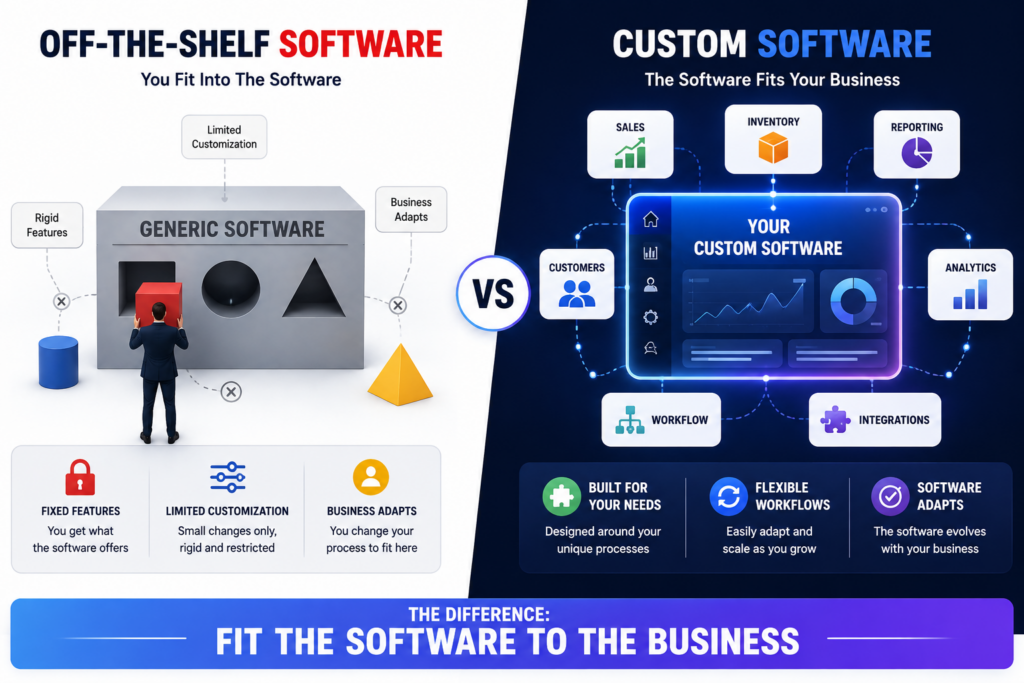
The choice between custom and ready-made software depends on the organization’s requirements.
| Factor | Off-the-Shelf Software | Custom Software |
|---|---|---|
| Initial availability | Usually immediate | Requires development |
| Customization | Often limited | High |
| Business-specific workflows | Limited | Strong |
| Scalability | Depends on provider | Can be designed around requirements |
| Integrations | Depends on available APIs | Can be built around required systems |
| User experience | Standardized | Business-specific |
| Long-term control | Provider-dependent | Greater organizational control |
| Development cost | Usually lower initially | Higher initial investment |
| Flexibility | Moderate to limited | High |
Off-the-shelf software can be the right choice when business requirements are simple and already supported.
Custom development becomes more compelling when existing solutions create operational limitations or when technology is strategically important to the organization.
How to Know If Your Business Needs Custom Software
Not every business needs custom development.
However, several signs can indicate that it may be time to consider it.
You Are Using Multiple Unconnected Systems
If employees constantly switch between applications or manually transfer information, integration or custom development could improve the workflow.
Your Existing Software Requires Too Many Workarounds
If teams regularly use spreadsheets, manual processes, or unofficial workarounds because the existing platform cannot support their requirements, customization may be worth evaluating.
Your Business Has Unique Processes
If your business model includes specialized workflows that standard applications cannot support, custom software can provide a better fit.
Your Business Is Growing
Growth often creates new requirements.
A system that worked when the business was small may become inefficient as the customer base, employees, transactions, and data volume increase.
Technology Is Becoming Part of Your Competitive Strategy
If digital experience is directly connected to how you attract, serve, or retain customers, software should be treated as a strategic investment rather than simply an operational expense.
The Custom Software Development Process
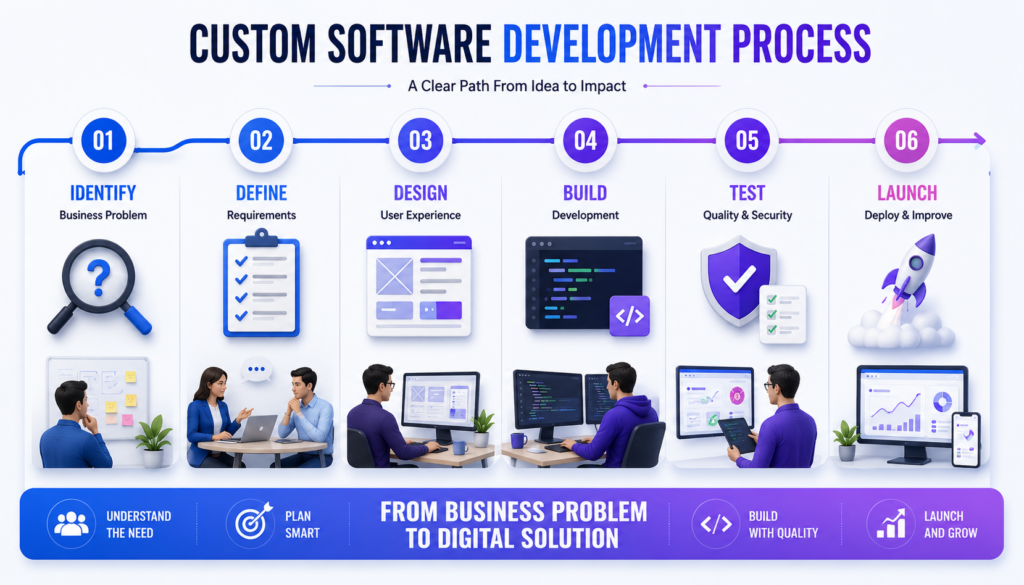
Choosing custom software is a significant decision. A structured development process can reduce risks and improve the final result.
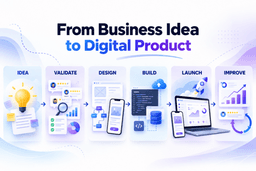
Step 1: Identify the Business Problem
The process should begin with the problem rather than the technology.
Ask:
- What is currently inefficient?
- Which tasks consume the most time?
- Where does data get duplicated?
- What do customers struggle with?
- What limitations exist in the current software?
Step 2: Define Requirements
Next, identify the essential features, users, workflows, integrations, security requirements, and expected outcomes.
Clear requirements help prevent unnecessary development.
Step 3: Design the User Experience
The interface should be designed around the people who will actually use the software.
Good UX can make complex systems easier to understand and navigate.
Step 4: Develop the Application
Developers then build the system using the appropriate technology stack.
Depending on the project, this may involve web development, mobile development, backend services, databases, APIs, cloud infrastructure, and third-party integrations.
Step 5: Test Thoroughly
Testing should cover functionality, usability, security, performance, compatibility, and edge cases.
The goal is to identify problems before the software reaches real users.
Step 6: Deploy and Monitor
After launch, the system should be monitored and maintained.
Software development does not necessarily end when an application goes live. Businesses may need security updates, performance improvements, new features, bug fixes, and integrations over time.
How Businesses Can Control Custom Software Costs
One common concern is development cost.
Custom software typically requires a larger initial investment than purchasing a ready-made subscription. However, businesses should evaluate the total value rather than focusing only on the initial price.
A practical approach is to begin with a clear Minimum Viable Product (MVP).
An MVP includes the most important functionality required to solve the primary business problem.
Later, additional features can be introduced based on actual user feedback and business priorities.
Businesses can also control costs by:
- Defining requirements early
- Prioritizing essential features
- Avoiding unnecessary complexity
- Choosing scalable architecture
- Planning integrations carefully
- Testing throughout development
- Establishing clear project milestones
The objective should not be to build the largest possible application. It should be to build the most useful solution for the business.
Custom Software Is a Long-Term Technology Investment
The most important shift in thinking is to view custom software as a long-term business investment.
A well-designed application can become part of the organization’s infrastructure for years.
It can support new customers, employees, services, markets, and business processes.
However, long-term value depends on more than development alone. Businesses should also consider maintenance, security, scalability, documentation, backups, monitoring, and future development.
This is why selecting an experienced development partner matters.
A reliable IT service provider can help businesses move from an initial idea to requirements, design, development, testing, deployment, and ongoing improvements.
Organizations researching custom development can explore the broader range of custom IT and software development services to understand how tailored applications and websites can support different business requirements.
What the Future Looks Like for Custom Software
The demand for customized digital solutions is likely to continue as businesses become more technology-driven.
Cloud computing, APIs, mobile applications, data analytics, cybersecurity, and modern web technologies are making it possible to create increasingly connected business systems.
At the same time, companies are becoming more aware that technology should support their unique strategy rather than force them into a predefined operating model.
The future of business software is therefore not necessarily about replacing every existing application.
Instead, it is about creating the right combination of tools, integrations, and custom solutions that help organizations work more effectively.
Businesses that understand their technology requirements early can make better decisions about where customization creates genuine value.
Conclusion
The growing interest in custom software reflects a simple business reality: no two organizations operate exactly the same way.
Ready-made software remains useful for many common requirements. However, businesses with specialized workflows, complex integrations, unique customer experiences, or ambitious growth plans may benefit from technology designed specifically for them.
Custom software can improve operational efficiency, provide greater flexibility, connect existing systems, strengthen control over business data, and create digital experiences that are difficult to achieve with generic products.
Most importantly, custom software allows technology to adapt to the business instead of forcing the business to adapt to the technology.
For companies evaluating this approach, the right starting point is not simply asking, “Should we build custom software?” The better question is, “Which business problems would a tailored digital solution solve better?”
When that answer is clear, custom development can become a practical and strategic investment. With the right planning, technology partner, and long-term development approach, a customized application or website can help a business become more efficient, adaptable, and prepared for future growth.
Tags
Share this article
About the Author
Experienced IT professional specializing in enterprise solutions and modern technology implementations.
Related Articles
Stay Updated
Get the latest IT insights delivered to your inbox.